Přihlaste se do našeho newsletteru!
The story of Marie Kudeříková shows how profoundly the Nazi occupation could transform the lives of young people, and how personal experience, the search for one’s own values and political stances intertwined with the pressures of the times. Her prison diaries and letters, which constitute an exceptionally powerful personal testimony, were misused after 1948 to create an image of a model communist heroine and martyr. Yet it was precisely this ideological “recasting” of her story that, paradoxically, contributed to her almost disappearing from the public sphere after 1989. The current marginalisation of Marie Kudeříková speaks less to the significance of her actions than to the ways in which society chooses its heroes and heroines. Her story thus serves as a reminder that historical memory is not fixed, but always depends on which values and themes are considered important and correct at any given time.
Marie Kudeříková was born on 24 March 1921 in Vnorovy (Hodonín district). Her father, Josef Kudeřík (born 1892 in Vnorovy), was an active public figure. During the First World War, he served in the Czechoslovak Legions on the Eastern Front and, upon his return, devoted himself to farming. In addition, he held a number of positions in the village for the People’s Party, including that of mayor, and was also involved in the Orel sports association. Her mother, Františka, née Kubíková (born 1900 in Vnorovy), helped run the farm. She also had a remarkable talent for art. She devoted herself primarily to painting folk ornamentation and traditional Slovácko art – the decoration of Easter eggs. Marie grew up alongside her younger siblings Alžběta and Josef, sharing the household with her grandparents and aunt. The family environment was rooted in the Catholic faith and intertwined with the traditions of the region known as Moravian Slovácko. Marie began her schooling at the local primary school, which stood right next to their family home at No. 432.
In the early 1930s, a significant change took place in the life of the Kudeřík family. As a former legionnaire, her father secured a job with the Czechoslovak State Railways and took up a post as an assistant railway clerk at Vrbovce station on the Moravian-Slovak border, on the line connecting Veselí nad Moravou, Myjava and Nové Mesto nad Váhom. The family therefore moved from to the station building in Vrbovce, Slovakia (now in the district of Myjava), situated at the foot of the White Carpathians.
Marie Kudeříková spent part of her youth here, which involved a daily commute to school. She attended the primary school in nearby Velká nad Veličkou, the largest village in the Horňácko region of Slovácko. After finishing primary school, in the late 1930s she began commuting to the grammar school in Strážnice, some twenty kilometres away. At the Strážnice grammar school, she met Julius Kramarics (who changed his surname to Kramarič after the war), a new classmate three years her senior who espoused communist and socialist ideals. Under his influence, Marie also began to familiarise herself with these ideas, which initially caused tension within the family. Over time, however, the situation calmed down and her parents accepted her relationship with Kramarics.
In her final year at grammar school, Marie was caught up in the Nazi occupation in March. As a result of the establishment of an independent Slovak state, the family had to leave Vrbovce and return to Vnorov. The Kudeříks resumed farming there, whilst Marie, together with her sister Alžběta, continued to commute to the grammar school in Strážnice. She completed her studies at the grammar school on 30 May 1940, passing her school-leaving exams with distinction. Her school-leaving essay, entitled ‘My Native Region’, was written in the form of a letter to her friend Lída, in which she expressed a strong attachment to her native Slovácko, reflected on the significance of art, and demonstrated her literary talent.
However, her future studies were fundamentally affected by the situation in the Protectorate of Bohemia and Moravia. Czech universities had been closed by the occupying authorities, and it was therefore necessary to seek other options for further study. Her parents eventually sent Marie to a one-year language school in Brno, which had been relocated to Veverská Bítýška (Brno-venkov district), a small town about twenty kilometres north-west of Brno. It was a private language school run by the Akademie association, and subjects taught there included shorthand, bookkeeping, typing and languages, which after the occupation were restricted to German lessons only. 1
Václav Dubský, a teacher at the language school in Veverská Bítýška, later recalled his meeting with Marie Kudeříková at that time: “I was fortunate enough to meet M. Kudeříková very closely, as her teacher at a private school during the 1940–41 academic year, and I continued to see her for several months afterwards, whilst she was working as a labourer at the RICO factory in Veverská Bítýška, the town where I spent the years of the Second World War. During those years, I was a member of an underground resistance organisation (R 3 – the Delta group). My acquaintance with Marie Kudeříková began in the first days of September, amidst very turbulent events, when the Gestapo, arrested several teachers from the aforementioned private school. At that time, together with Marie Kudeříková, we attempted to warn two of these members of the school’s teaching staff against arrest, even at the cost of immediate personal risk. We succeeded, and this event gave rise to mutual trust between us.” 2
As V. Dubský further notes, the small age gap between teachers and pupils led to the formation of informal discussion groups, in which Marie Kudeříková stood out for the depth of her reflections, particularly during debates on philosophical and political topics. During one of the debates on the subject of religion and the Church, Marie Kudeříková so impressed the others with her carefully prepared speech that Václav Dubský requested and kept her written notes dated 22 October 1940. The text reveals her markedly critical stance towards the Catholic Church and its teachings, which, in her view, had abandoned Christ’s original moral message, failed throughout history, and kept the faithful in line through dogma, fear of punishment and the promise of reward; she also viewed the Bible sceptically as a text influenced by tradition and the evolution of thought. Instead, she formulates her own conception of God as an inner force present in the world and in human beings, which is neither a judge nor a rewarder. At the same time, she situates her stance within her personal development: moving gradually away from her original Catholic faith, inherited from her family background, on the basis of her own experiences and critical reflection, whilst regarding faith in humanity and an ethics based on mutual responsibility as key. 3
This emphasis on individual assessment of people and the rejection of simplistic judgements also appears later in her reflections, in her prison notes: “I always approached people with an open mind. I did not accept others’ classifications: that one is a thief, that one a prostitute, that one an immoral person. No. To me, they were people; I judged them only through my own understanding, from the perspective of my worldview, justice and compassion. And I always wanted to help them, if they deserved it. That is why I gained their trust; perhaps they sensed it…” 4
Sometime during the period when M. Kudeříková was working in Veverská Bítýška, her relationship with Julius Kramarics also came to an end. He subsequently left to work in Germany and did not return until the spring of 1945. Later communist interpretations of their break-up were primarily political in nature – Julius was said to have opposed Marie’s involvement in the underground resistance. However, as her later prison notes suggest, the reasons for the break-up were more complex and cannot be reduced to a single perspective. 5
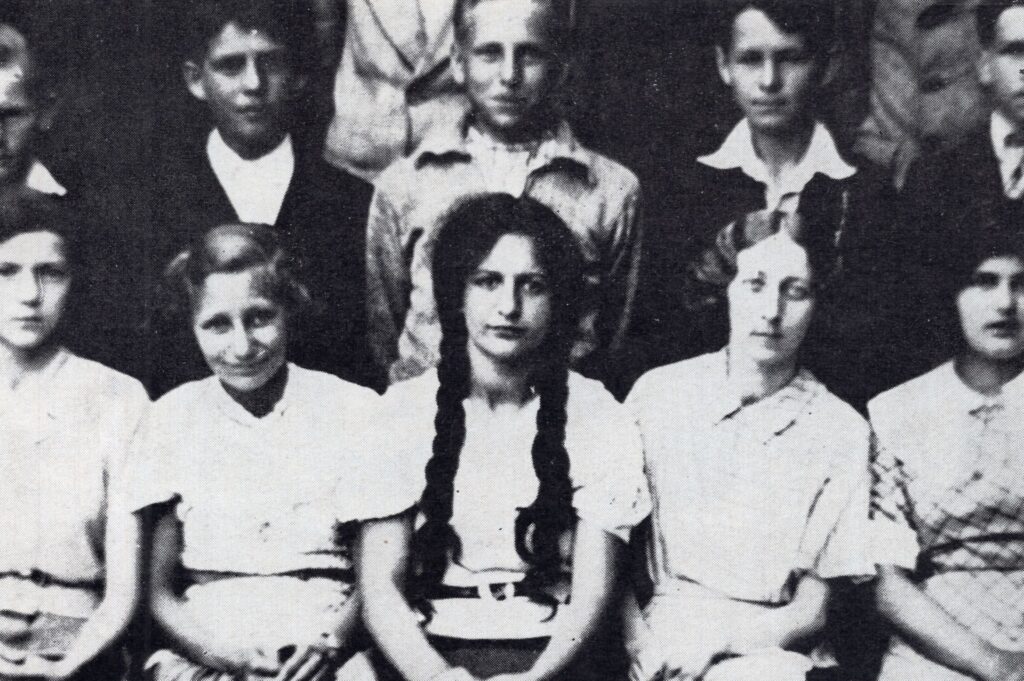
A precise description and more detailed account of Marie Kudeříková’s resistance activities are still lacking. The surviving sources are fragmentary and often indirect, whether based on later recollections, contemporary testimonies or interpretations that emerged only after the war. Many specific details of her activities thus remain unclear, and in some cases it is difficult to distinguish documented facts from later interpretations, which were moreover influenced by shifts in the political and historical context.
As Lumír Kuchař, Maria’s classmate from the Strážnice grammar school and author of several laudatory publications on her life, noted after the war, her involvement in illegal activities began to take shape during her grammar school studies. She established contacts that gradually led her to active resistance against the Nazi regime. Her classmate and friend Julius Kramarics played a significant role, initially sparking her interest in political events and left-wing ideas. Through him, she met Josef Petrucha (1912–1942), a labourer from Veselí nad Moravou, known locally as ‘Jožka the Communist’. He lent the students left-wing magazines and various propaganda materials. It was with him that Marie and Julius were said to have discussed joining the Communist Party. Marie reportedly took her first concrete step towards illegal activity as early as 1939, when she and Julius collected leaflets from Petrucha containing the Communist Party of Czechoslovakia’s proclamation for 15 March 1939. Petrucha was later arrested and, in 1942, interned at the Auschwitz concentration camp, where he perished that same year.
Another figure mentioned who influenced Marie was Josef Řičica, a shoemaker from Vnorov. Local residents gathered in his workshop not only for political debates, but during the occupation, resistance activities also developed there. Řičica was also arrested by the Gestapo and later died in a concentration camp. 6
Krátce po okupaci začala Marie Kudeříková spolupracovat také s Františkem Jagošem z Velké nad Veličkou, jejím bývalým učitelem ze strážnického gymnázia, který organizoval ilegální přechody přes hranici na Slovensko. Jagoš ji prý nejprve pověřil přenesením ilegální písemné zásilky na slovenskou stranu a po úspěšném splnění tohoto úkolu ji postupně zapojoval do další činnosti. Horský terén moravsko-slovenského pomezí, pokrytý hustými lesy, vytvářel vhodné podmínky pro ilegální přechody hranice, jimiž prošly stovky lidí. Marie Kudeříková tento kraj dobře znala, a proto se na převádění uprchlíků úspěšně podílela. Do převádění byl zřejmě zapojen také její otec Josef Kudeřík. Vedle toho se Marie angažovala i v dalších formách odboje – rozšiřovala ilegální letáky a přenášela přes hranice důležité zprávy. 7
Po maturitě v roce 1940 byla dosavadní odbojová činnost Marie Kudeříkové na moravsko-slovenském pomezí přerušena odchodem na jednoroční jazykovou školu do Veverské Bítýšky. Během krátké doby se i v novém prostředí zapojila do ilegální činnosti, tentokrát v rámci širších struktur odboje na Brněnsku. 8
Jindřiška Patočková (née Klímová) from Veverská Bítýška, who worked as a teacher and later as headmistress of the local primary school after the war, also recalled Marie Kudeříková after 2011. Among other things, she mentioned that her uncle Kratochvíl had taught Marie Kudeříková at the grammar school in Strážnice and that it was he who had informed her about the opening of the language school in Veverská Bítýška. “In 1939, Marie Kudeříková became a student and lived with us. We liked her. She was lovely. She read books by T. G. Masaryk. Mum sewed dresses for her. She really became part of our family. I remember that my mother came to visit her. She was wearing traditional costume. They didn’t go to bed at all. They walked around outside all night and talked. And talked. My mother was worried about her. She knew how dangerous it was and had come to persuade her to give up her resistance activities and return home. She left empty-handed.” 9
In V. Bítýška, Marie lived with the Klíma family in a secluded cottage on the banks of the River Svratka at the foot of a steep slope known as ‘Pod horkou’. At that time, she gave Jindřiška Patočková a copy of the book “Babička” by Božena Němcová, in which she wrote a dedication dated 28 November 1940: “Jindřiška, learn to love the Czech nation, the Czech land and all people as much as “Babička” taught her children. To love means to listen to and bring joy to those we love. That is what President Masaryk used to say. So be good and bring joy to people by studying hard and helping others.” 10
At that time, Marie Kudeříková was apparently already collaborating with the underground group the Communist Union of the Young Generation (hereinafter KSMG), a resistance organisation of left-wing orientated youth, which was founded in early 1940. The Union operated under the direct leadership of the underground Communist Party of Czechoslovakia (hereinafter KSČ) and was involved in sabotage, the distribution of underground publications and other forms of resistance against the Nazi regime. At the turn of 1940–1941, it also published the underground magazine Mladá garda.
M. Kudeříková quickly gained trust and became involved in more organisationally demanding tasks. She became a member of the regional and later provincial leadership of the KSMG and acted as a liaison, ensuring contact between the individual cells. In this role, she travelled around the Brno area and to more distant Moravian villages, where she instructed the so-called ‘trojky’, i.e. the basic cells of the communist resistance, each consisting of three people. This system was intended to limit the impact of any arrests, as the individual groups were isolated from one another and connected only through liaisons. 11
There is an anecdote from this period, recorded after the war in several versions with minor variations, which eloquently illustrates her presence of mind and ability to act under pressure. According to one version, during a luggage check at Brno railway station, she found herself in immediate danger as she was carrying explosives. However, she remained completely calm: she pinned on a German badge with a swastika, addressed a German soldier in fluent German to ask for directions to Královo Pole, thereby diverting attention from herself and thus evading the security check. 12
Gradually, she also gathered around her a group of young people from Veverská Bítýška and the surrounding villages, whose activities she organised and directed. In addition to her organisational work, she took part in a whole range of specific tasks: she reproduced and distributed illegal printed material, secured supplies for the resistance, including paper, stencils, money, weapons and explosives, and was also involved in acts of sabotage, for example in factories or on the railways. 13
After completing language school, where she passed her final exams, she remained in Veverská Bítýška for several more months. She worked as a weaver in a local factory, which had been run there since 1938 by the Brno entrepreneur Cyril Ráček 14 and which specialised in the production of medical and hygiene products (later RICO 15 ). She was assigned to this company by the employment office, as, being born in 1921, she was subject to compulsory labour. At the same time, she continued her underground activities. Together with her female colleagues at the factory, she successfully sabotaged production and even attempted to set fire to the factory warehouse. Other forms of sabotage she carried out at the time included placing nails under the wheels of buses transporting workers to work, pouring crushed glass and sand into the bearings of train wheels, and cutting telegraph wires. 16
Marie Kudeříková, as a member of the Communist Union of the Young Generation, is sometimes also linked to the assassination in Letovice. On the night of 20–21 September 1941, one of the trios from the Boskovice resistance group ‘Za svobodu’ (For Freedom) attempted to blow up the local Lamplota Hotel, which at the time served as accommodation for members of the Hitler Youth. The operation was more of a symbolic gesture, and no lives were lost. However, no direct link between this operation and M. Kudeříková is documented in the available sources. 17
The Communist Union of the Young Generation was gradually broken up by the Gestapo during the summer and autumn of 1941, and the resistance network in the Brno area was significantly weakened. The wave of arrests also affected Marie’s circle of associates. According to the recollections of Jindřiška Patočková, Marie Kudeříková spent the summer holidays of 1941 in Veverská Bítýška, once again with her family. However, she soon had to leave there – J. Patočková said of this: “I remember that Constable Ondráček (a very good friend of ours) came to see us and warned my parents about the danger of anonymous letters. Their content pointed to Marie Kudeříková’s resistance activities. On the basis of this information, she decided to leave Bitýška. She then went to Lažánky, where she worked on a farm.”¨18
As the situation continued to escalate, Marie Kudeříková decided to leave for Brno at the end of 1941. There she was transferred to the Brno branch of the Ráček company at 9 Francouzská Street 19 and at the same time tried to establish new contacts and continue her underground activities. According to some accounts, she even attempted a daring solo act of sabotage, during which she damaged machinery in the factory at night. 20
Marie Kudeříková was arrested on 5 December 1941, when she was detained by the Gestapo as part of an investigation into illegal resistance activities. She was apparently arrested directly at the Ráček factory on Francouzská Street in Brno. The circumstances of her arrest are not interpreted entirely uniformly. It is most commonly stated that during interrogations she was betrayed by one of her colleagues from the illegal communist resistance group, whose identity we do not know precisely. He was later convicted and executed alongside Marie. 21
Another possible cause often mentioned is a breach of security protocols by Marie Kudeříková – specifically, a personal letter she left in a parcel intended for another member of the resistance. This was likely Rudolf Dufek (born 1920 in Veverské Knínice) from Čebín. As the first of the trio of young members of the Communist Union of the Young Generation whom Kudeříková had instructed, he was arrested as early as the end of November 1941 (executed in Wrocław for preparing high treason on the same day as M. Kudeříková, i.e. 26 March 1943 22 ). By an unfortunate coincidence, she had left a letter addressed to her friend from language school amongst the leaflets at his place. 23
The news of Marie Kudeříková’s arrest had an immediate impact on the community in Veverská Bítýška. Even decades later, eyewitness Jindřiška Patočková recalled this moment as a deeply traumatic childhood experience: “I know it was winter. My parents were chopping wood. My mother’s sister, Anička Bajerová, came to visit and told us that Maruška had been arrested. By a coincidence, my mother had sent Maruška a parcel by post that very day. It contained her personal belongings that she still had at our house. And I wrote a letter to Maruška, in which I told her how much I missed her… how sorry I was that she hadn’t even said goodbye to me… that she only came to see us at night… that I hadn’t seen her… and so on… I remember how, as a 10-year-old girl, I realised the gravity of the situation and told my mum what was in my letter. She didn’t read the contents, of course; she simply packed it in with the other items in the parcel and took it to the post office. My message terrified her. The possible consequences for our whole family once the letter reached the address of the arrested woman were immediately crystal clear to her. She made up her mind and went to the post office. The parcel hadn’t yet been taken to Brno. Mum managed to get it back. We were very lucky.” 24
As is evident from surviving Gestapo documents 25 , following her arrest, Marie Kudeříková was initially detained and interrogated in Brno, specifically at the prison on Cejl Street (now the site of Káznice) and at the Gestapo headquarters at the time, located in the Faculty of Law building on Veveří Street. From there, she was transferred first to the prison in Jihlava and subsequently to the prison in Prague-Pankrác, from where she was taken for interrogation to the Gestapo headquarters in the former Petschek Palace. When she still refused to speak even in the infamous ‘Pečkárna’, a second transport to Jihlava followed on 9 January 1942, where she spent eight days, and on 18 January she was transferred back to Brno. 26
She later recalled the interrogations in one of her letters to her mother from prison as long and exhausting procedures, during which physical coercion alternated with intense psychological humiliation: “The beatings weren’t so terrible, and compared to the men, there were far fewer of them. Perhaps they sensed their futility. But that mental humiliation and spitting in the face of a woman and a human being! That repulsive laughter at crude jokes! […] Once they threw a fuse coiled into a circle at my head and cackled as they did so.” She also recalled the forms of punishment in the Prague prison, such as being forced to stand facing the wall for up to thirty hours or repeated sets of squats. 27
M. Kudeříková’s stance during interrogations, reportedly characterised in Gestapo records as “hartnäckiges Schweigen” (stubborn silence) 28 , became one of the most striking themes of her story after the war. At the same time, however, it was not merely a matter of passively refusing to testify: in order to protect other members and her colleagues, she identified her organisation as the independent Brno city leadership of the Communist Union of the Young Generation. 29
This account was later corroborated by Jaromíra Kryslová, who shared a prison cell with Kudeříková in Wrocław and in 1967 published a memoir based on personal experience and surviving documents. In doing so, she quoted from a report by the Gestapo’s Fourth Department, which stated:
“The city leadership was headed by Marie Kudeříková, a member of the Protectorate… On the night of 20 September 1941, the city leadership distributed leaflets in Brno-Líšeň and Letovice. The leaflets contained a call to farmers to sabotage supplies. Kudeříková was not only involved in distributing illegal material and producing at least 1,000 such leaflets, but also in promoting sabotage activities in workshops. In the ‘Work Slowly’ campaign, she gave a talk on damaging machinery and, on behalf of the central leadership, organised the derailment of freight wagons on railway lines in the Protectorate. The attempt failed due to a lack of technical resources on the part of the city leadership.” 30 According to M. Gygar, this report on the activities of the Brno group of the Communist Union of the Young Generation was even included on 1 May 1942 in a summary report which the security services regularly prepared directly for Hitler’s headquarters. 31
“So today I was troubled again by the thought of whether it was not my duty to show consideration and caution even towards myself. Well then. I have not harmed anyone with my words, if I review my statements once more. What they said about themselves is their own affair and not a matter for my conscience. What they said about me, I forgive them from the bottom of my heart. At first glance, it seems I made about three serious mistakes against myself. But that is only an illusion. In that situation and under those circumstances, they were not mistakes. When I admitted that I had made those leaflets myself, I wanted to establish a foothold for my subsequent statements, to which I could refer. The other two apparent mistakes—the things I admitted—were claimed by two or three witnesses, one of whom was as silent as a wax figure and impossible to communicate with. Coming clean was the best thing to do, though at the same time the worst, because I would have been accused of lying, of deliberate denial, and that would only have made my position in court more difficult. The point is that this group was the ‘city leadership’, and then there was the passing on of sabotage orders. To deny it would have been no act of heroism, but it would have been pointless, as I can confirm today after these experiences. Even though I hardly thought of myself at all, which was reckless. But under these circumstances, it didn’t matter. I didn’t give a single clue, let alone the name of any of them. And I tried to help them during the interrogation. Designating this group as the ‘city leadership’ was welcome to me at the time, because it encompassed everything and covered up the possibility that something else might exist in the city. I think I would have found it terribly hard to live and die if I had soiled my shield in the slightest.” 32
After the investigation concluded on 17 June 1942, she was transferred to the prison in Vratislav (then Breslau, now Wrocław in Poland), where she was put on trial together with two other members of a three-person illegal group of Communist youth. The main hearing took place on 16 November 1942, at which the court found M. Kudeříková guilty of high treason and sentenced her to death by beheading with an axe. 33
After the verdict was handed down, Marie Kudeříková was placed in the women’s wing of the Wrocław prison in the so-called ‘death row cell’, where she waited for four months for an unspecified execution date. Contact with her family was very limited: a letter from home could arrive only once or twice a month, and visits were subject to the permission of the prison authorities. Marie was allowed a brief meeting with her family in January and then, for the last time, in February 1943. 34
Jaromíra Kryslová (1913–1989) and Vítězslava Vylegalová (born 1921, married name Hejzlarová after the war) also found themselves in the same prison; they too had been arrested for participating in the illegal anti-Nazi movement, and Marie secretly exchanged short notes with them. In these, they shared their impressions, reflections and observations, commented on events in the prison and news from the Eastern Front, and copied their favourite verses and songs for one another. When Marie was sentenced to death and it became clear that she had only a few months left to live, she began systematically writing down her thoughts, reflections and memories. This was made possible by her work in her cell, where she painted children’s toys and thus had access to writing materials. 35
In her death cell, she wrote more than thirty texts which – like other prisoners – she called ‘scribbles’ and collectively described as ‘fragments of life and thought’. 36 The surviving notes, published after the war under the title “Fragments of Life”, 37 were written between 6 December 1942 and 26 March 1943, when she was executed. Some of the notes were secretly handed over during a visit to Jaromíra Kryslová’s mother, who passed them on to Marie’s parents; others were sent, with the help of a trustworthy guard, to an agreed address belonging to one of Jaromíra’s relatives and from there to Vnorov. Once this connection had been established, Marie began to write her texts more and more frequently as letters addressed to specific recipients. She herself remarked on them: “I know that these scribbles are of little value, because every individual matured through their own more or less painful process. But they are certainly of value to my loved ones, to those who knew me and could not explain many things…” 38
Her prison writings, however, do not take a single form: alongside diary entries and profound self-reflections, they contain letters to her family and fellow prisoners, as well as flashbacks to the past – memories of childhood, home, romantic relationships and, more generally, the time before her imprisonment – whilst the prison regime itself is rarely described. In her notes, she also repeatedly returns to questions of religion, rejecting the Catholic faith and critically confronting it with her communist convictions. Among the notes, copies of verses by favourite Czech poets have also been preserved, such as Vítězslav Nezval, Jaroslav Seifert and Jiří Wolker. She also reflected critically on her own actions: “You know that I regret nothing, that I would live my life exactly the same way without hesitation; only, perhaps after these experiences, I would make better use of the circumstances. I would wish for that. I regret only the evil and the mistakes.” 39
Both the Kudeřík parents and Marie herself, through their defence counsel, repeatedly and unsuccessfully attempted to have the verdict overturned. In her letters, the question of a pardon, reflections on the possibility of a pardon, and hopes for survival appear quite frequently and, as time went on, with increasing regularity.
On 14 January 1943, Marie wrote: “My parents sent a request to the Volksgericht (People’s Court, note by MS), the Protector, the government, and the President. It was drafted by my defence lawyer, with whom they are still in contact. Mum blames herself for not getting me my own defence lawyer. I reassured her that it’s pointless. He couldn’t have done any more. The poor woman offered to go and work to save my life. attached a certificate from the German border authorities (with whom we lived for three whole years at the station), the Zollamt (customs office, note by MS) and the border police attesting to the good conduct of the whole family. Father once found a revolver; one of them had lost it, so he handed it in. That is how he gained their trust in his honesty and absolute loyalty, and the head of the office wrote a certificate about this act, which they attached. That was truly a triumph! Mum wanted to go to Berlin, but I talked her out of it. Where to? She’s trembling, afraid of missing something, of letting something slip by, my mum.” 40
A month later, on 13 February 1943, Marie Kudeříková stated in a message to her fellow prisoners that she would attempt to draft a new petition for clemency, which might at least delay the execution of the sentence. She was considering the following grounds:
“I did everything solely on orders and was not in charge. Whilst in custody, I realised the full extent of the consequences of the whole affair, something I hadn’t realised whilst on the outside. I tried to make amends throughout by working hard and behaving well. I did nothing wrong and worked diligently. Even after the verdict, I behaved well and worked hard, yet I was severely punished afterwards. I realise that my actions caused harm, which I wish to make amends for through my work in the future. I regret everything and ask for the opportunity to prove my good intentions, as I have already done whilst in custody.” 41
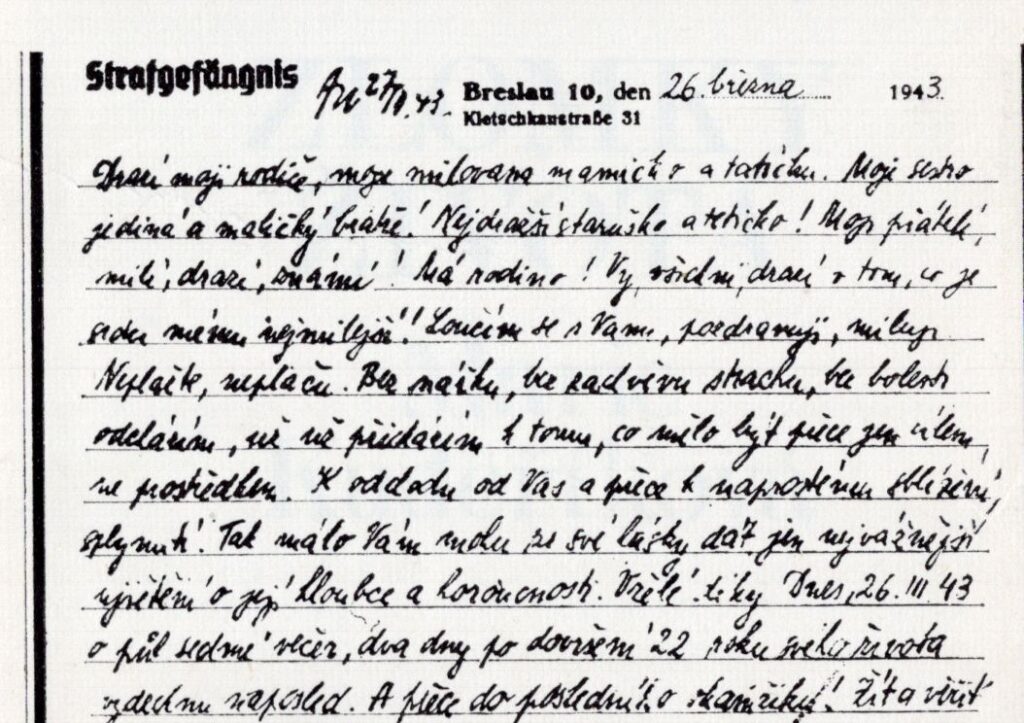
Despite these efforts and repeated attempts to have her sentence commuted, Marie Kudeříková’s situation remained unchanged. Her appeals for clemency went unheeded, and her fate remained uncertain for weeks on end. It was not until the morning of 26 March 1943 that she was informed the sentence would be carried out that very day. Immediately afterwards, she sat down to write her final farewell letter, addressed primarily to her family. In it, she displayed extraordinary inner strength and composure. After the war, the text became one of Marie Kudeříková’s most frequently quoted prison writings. In its opening, she writes:
“My dear parents, my beloved mum and dad! My only sister and little brother! My dearest grandmother and aunt! My friends, my dear ones, my loved ones, my acquaintances. My family! All of you, dearest to my heart!
I bid you farewell, I send my greetings, I love you. Do not weep, I am not weeping. Without lament, without a tremor of fear, without pain I depart; I am already approaching that which was meant to be at the very end, not in the middle. A departure from you, and yet a complete union, a merging. So little can I give you of my love, only the most solemn assurance of its depth and fervour. My heartfelt thanks. Today, 26 March 1943, at half past six in the evening, two days after turning twenty-two, I shall breathe my last. And yet, until the very last moment! To live and to believe! I have always had the courage to live, and I do not lose it even in the face of what is called death in human language.
I would like to take upon myself all your sorrow, all your pain. I feel the strength to bear it for you, the desire to take it with me. Please, please, take it upon yourselves too, do not suffer, do not weep! I love you, I cherish you! My spirits were always lifted when I read your words! You did everything that was in your human and loving power. Do not blame yourselves for anything; I know everything, I feel everything, I read everything in your hearts.“
In the following passages of the letter, Marie turns to her loved ones with a plea that they should not accept her death as a cause for lasting grief, but as an inspiration for a life filled with love and mutual closeness. She expresses gratitude to her family, asks for forgiveness for her own mistakes, and at the same time assures them that she is departing at peace, without fear, and with a clear understanding of the meaning of her actions. The text also contains a specific gesture of final farewell, as Marie bequeaths her hair to her family as a tangible memento. The conclusion of the letter then sums up this sense of personal closeness and serenity with the words:
I love you all; I am leaving with faith, firm faith. Your loving daughter
Marie KudeříkováGreetings to all. Forgiveness. Thanks. Love. I am with you. My thanks and love to you!
M. K.
I am leaving without fear!
I tied my own hair. I sent a message and a kiss with it. It will be packed with my belongings, which you may ask for!”42
Marie Kudeříková’s execution took place on Friday 26 March 1943 at 6.42 pm, two days after her twenty-second birthday. She was the seventh of nine condemned prisoners to be executed in Wrocław on that day. 43According to the testimony of her cellmate on death row, Julie Gutová, she went to her execution calmly and proudly. 44
Immediately after the Second World War, the story of Marie Kudeříková appeared rather fragmentarily and often anonymously, as evidenced by the press of the time, which initially worked with generalised portrayals of young members of the anti-Nazi resistance without specific names. The emphasis was primarily on her patriotic sentiment, whilst her “political convictions” did not yet play a major role. Alongside minor references in the press, usually in the form of shorter or longer excerpts from her final letter, her name appeared primarily in a regional context. For example, during the “national memorial service for national martyrs” in July 1945 in Strážnice, “Mařenka Kudeříková” was mentioned as the only woman among the fallen from the region.45
A shift occurred in 1946 with the publication of “Poslední dopisy” (Last Letters)46, which featured a foreword by the poet František Halas and collected authentic texts from 31 executed resistance fighters, including, for example, Julius Fučík (his “Reportáž psaná na oprátce” was first published in 1945). Marie Kudeříková was represented here alongside five other women, and her letter, written on the day of her execution, was placed within the broader framework of ‘heroic death’ and moral sacrifice, with the emphasis placed more on the existential dimension of her final moments than on the specific course of her resistance activities.
The commemoration of Marie Kudeříková had already begun to intertwine with political discourse during this period. The Communist Party of Czechoslovakia’s pre-election strategy in 1946 relied, among other things, on emphasising the Communist “national liberation struggle” during the war, and specific stories of resistance fighters were placed within this framework. The motif of sacrifice was used to legitimise political claims and to mobilise the electorate. For example, on election day, the Brno newspaper Rovnost published excerpts from the final letters of several communist resistance fighters, with the most space devoted to Marie Kudeříková’s letter. 47
A text by the journalist Anna Tučková in the 1954 anthology “They Loved Their Nation” had a fundamental influence on how Marie Kudeříková’s story was told at this time. It was here that the manner in which M. Kudeříková was presented to the public became established – as a young communist heroine, with an emphasis on her youth, beauty, smile and moral purity. The narrative traces her journey from a Catholic upbringing to her gradual embrace of Marxism. The story is also linked to the figure of Julius Fučík and set within the broader context of the communist resistance. It features recurring, striking iconic motifs designed to reinforce the image of a steadfast and determined heroine. The conclusion is her death, presented as a peaceful and conscious sacrifice for a better future. The entire narrative is constructed to have a powerful emotional impact whilst offering a clear role model with whom readers are meant to identify. An example is the passage in which ‘Maruška’ and ‘Jula’ walk together through the park by Strážnice Castle, discussing literature, Marxism and their relationship to religion, and spending their time in ‘lively debates’: ‘How fruitful this friendship between lovers is, how both young people grow through it and blossom !’ 48
The image of Marie Kudeříková gradually stabilised and became institutionalised in the 1950s: it became part of school curricula, educational activities and the public sphere, and was deliberately used to shape collective memory and the ideological education of young people. At the same time, the way she was referred to also became established – alongside her official name, the diminutive “Maruška” was commonly used, intended to emphasise her youth and bring her closer to the younger generation.
In the early 1960s, there was a significant shift in the way Marie Kudeříková was remembered with the publication of the book “Zlomky života” (1961), which was released to mark the 40th anniversary of the founding of the Communist Party of Czechoslovakia and made her own prison diaries and secret correspondence available to the public for the first time. The publication marked a fundamental change – readers were no longer reliant solely on mediated and ideologically filtered interpretations, but gained access to authentic texts. Following the publication of “Zlomky života”, however, the cult of M. Kudeříková flourished even further, and just as with Julius Fučík, she too was gradually stylised in the press into an almost “saint-like” figure. The book was published in several editions (1961, 1962, 1965, 1975) with a total print run of almost 49,000 copies. The first two editions were identical and contained a foreword by the literary theorist Mojmír Grygar,49 who emphasised the literary value of the text and ranked it among the significant works of anti-fascist literature alongside Julius Fučík’s “Reportage Written on the Gallows” and “The Diary of Anne Frank”. The third edition, published in 1965, was expanded to include several new letters and an illustrated supplement, and, compared to previous versions, places greater emphasis on the biographical dimension and the complexity of M. Kudeříková’s personality. Her communist identity is not emphasised so directly; her story is presented more as an example of a person striving for a fairer and freer world, thus representing a certain shift away from the schematic portrayal of the 1950s.50
The shift in the political climate following the occupation in August 1968 was also significantly reflected in the interpretations of Marie Kudeříková’s story. The normalisation discourse promoted the ‘only correct’ version of the past, which was also reflected in the treatment of her notes and letters: whilst they were presented as authentic evidence, they were simultaneously selectively chosen, combined and placed within a predetermined ideological framework. Her story thus served primarily as a tool for legitimising the regime.
In the 1970s, Marie Kudeříková had a significant presence in the public sphere. Her name and image appeared in the press, in school materials and in various cultural and artistic forms. The literary competition ‘Strážnice Marušky Kudeříkové’, established in 1961 to honour her memory and promote pupils’ literary creativity, also played a significant role. Originally a district-level competition, it quickly transformed into a mass nationwide event with thousands of entries annually; it became more heavily ideologised and integrated into school practice.51 In addition, hiking treks were organised in honour of M. Kudeříková, commemorative plaques and monuments were erected, and streets, schools, Pioneer groups and agricultural cooperatives were named after her. Kudeříková was symbolically registered as an honorary member of work collectives and her name appeared in the commitments of socialist work brigades.
In 1973, a postage stamp bearing her likeness (alongside Jožka Jabůrková, another state-celebrated anti-Nazi resistance fighter) was issued in a print run of over six and a half million copies.52 In 1978, the Marie Kudeříková Memorial Hall was established in Vnorovy as part of her birthplace. The only film adaptation to date – the film “…a pozdravuji vlaštovky” directed by Jaromil Jireš (1972) – also played a significant role. 53 In 1977, Zora Beráková’s novel “Zkouška dospělosti” was published, which remains to this day the only fictional adaptation of M. Kudeříková’s story. Her story also inspired other works of art, including the ballet based on her prison letters, “Fragments of Life and Dream” (1976), and composer Václav Felix’s “Symphony for Female Voice and Orchestra to the Words of Marie Kudeříková” (1974).54 In 1981, a play for young people, “An Hour in the Sign of Darkness”, directed by Jan Tůma, was also produced at the Czechoslovak Radio studio in Brno. 55 The end of this period also saw the release of the album “Slzy Marie Kudeříkové” (The Tears of Marie Kudeříková), featuring the ironic song of the same name, released by the Pilsen punk band Požár mlýna in early 1990.56
The image of Marie Kudeříková gradually became ritualised in the everyday life of socialist society during the 1970s and 1980s. She thus evolved from a historical figure into a permanently present symbol intended to motivate and shape ideology. Yet – or rather precisely because of this – she gradually lost her ability to make a strong impact on her audience and, with it, her vitality: she became confined to schematic interpretations, her emotional impact waned, and she increasingly transformed into a static, ritualised and hollow symbol.57
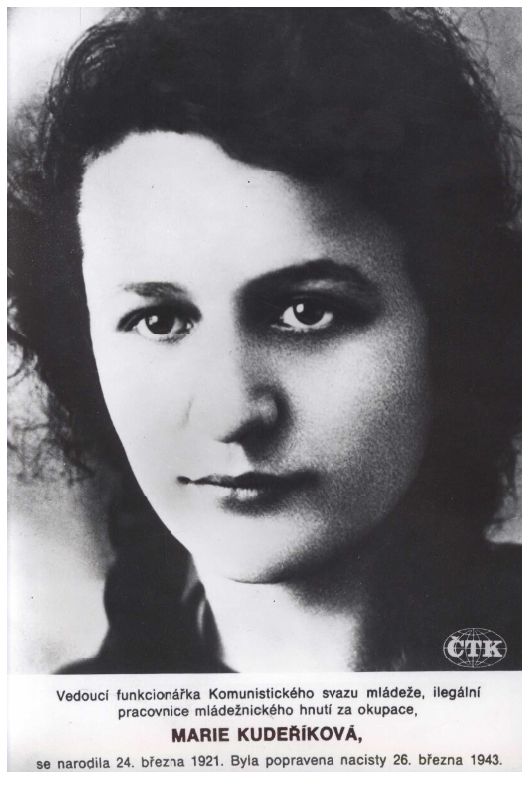
After 1989, there was a fundamental shift in the interpretation and public presence of Marie Kudeříková’s story. With the fall of the communist regime, the ideological framework that had shaped and institutionalised her legacy collapsed. As a result of the re-evaluation of the past, figures associated with the communist resistance were pushed to the margins of public interest, which significantly affected M. Kudeříková as well. This was driven by the strong anti-communist framework of the new regime, as well as the generational experience of those who had previously been subjected to the myth of normalisation and were now distancing themselves from it. Whilst, for example, the legacy of Julius Fučík had already been questioned from the early 1990s as fabricated or, at the very least, heavily embellished, the name of Marie Kudeříková was quietly fading from the public sphere. This process was also reflected in specific interventions in the public sphere – the removal of commemorative plaques, the renaming of institutions or streets, and their disappearance from teaching and public memory.
A telling example of this approach is the situation in Brno, where Marie Kudeříková’s commemorative plaque was removed and placed in the Brno City Museum’s repository as early as 1990. Immediately afterwards, the street on which the plaque had stood since 1956 was renamed from October Revolution Avenue to Milada Horáková Street.58 This move has a strong symbolic dimension: whilst the memory of M. Kudeříková as a representative of the communist resistance was suppressed, a female figure from the anti-communist resistance was simultaneously introduced into the public sphere, becoming one of the new symbols of the post-revolutionary period. 59
Interest in the legacy of Marie Kudeříková only emerged more prominently in 2002, when Czech Television broadcast the documentary by director Ján Novák, ‘Memories of Me…’, 60 which criticised the alleged unpreparedness and ineffectiveness of her resistance activities; however, according to some interpretations, it came across more as an attempt at discrediting her than as a balanced analysis or a contribution of new insights. The 100th anniversary of her birth in 2021 marked a milestone in this renewed interest. The Meeting Brno festival was dedicated to her legacy, with the story of this resistance fighter forming one of its main thematic strands. For this occasion, sculptor Pavel Karous created an updated monument to M. Kudeříková, realised as an intervention in the original monument by sculptor Zdeněk Preclík from 1976 on Kpt. Jaroše Avenue in Brno. 61 An episode of Pavel Karous’s programme “Vetřelci a plameňáci” (Aliens and Flamingos) was also produced for the internet television channel Stream, dedicated to the monuments, statues and commemorative plaques honouring Marie Kudeříková. 62 In 2021, a dance performance entitled “Maruška” was staged in Brno based on her letters, and a film adaptation of this production was later broadcast on Czech Television. 63 In the same year, the premiere of the production “A neříkej mi Maruško” (And Don’t Call Me Maruška), inspired by the life and legacy of M. Kudeříková, took place at the Venuše Theatre in Švehlovka, Prague.64
However, the story of Marie Kudeříková remains largely marginal in the wider public consciousness and has not attracted significant interest from the academic community either. To date, no systematic historical research into her life and resistance activities has been carried out, and there is also a lack of academic studies or monographs on the subject. An exception is Daniela Poláková’s master’s thesis, which focuses on the transformations in the post-war representation of the myth of M. Kudeříková. 65 Compared to other figures of the anti-Nazi resistance, her story is not systematically commemorated and rarely appears in popular or educational contexts. A significant, albeit rather isolated, expression of modern recognition is the fact that on 8 May 2025, M. Kudeříková was posthumously awarded the Cross of Defence of the State by the Minister of Defence of the Czech Republic.66
The stories of women involved in the anti-Nazi resistance were long sidelined after the Second World War or reduced to schematic and ideologically convenient portrayals, as was the case with Marie Kudeříková. Her personal experience, motivations and everyday life receded into the background in favour of a symbolic role. This story thus clearly illustrates how historical memory changes according to the era in which it is formed. From post-war commemoration, through the strong ideologisation of the socialist period, to the post-revolutionary withdrawal from the public sphere, one can observe how a specific historical figure becomes a shifting symbol.
Individual stories are often simplified, adapted or exploited for various social and political purposes – not only in the past, but also in the present. Every era, after all, creates its own heroes and heroines to serve its own ends. M. Kudeříková’s ‘second life’, that is, the way her story is remembered, thus always reflects the values and needs of the time. Both the former communist mythologisation and later attempts to cast doubt on it represent different ways of interpreting the same story. The purpose of today’s view of Marie Kudeříková should be neither her uncritical glorification nor her rejection, but an effort to understand her life within its true historical context.