Melden Sie sich für unseren Newsletter an
Following the establishment of the Protectorate of Bohemia and Moravia, Roma and Sinti became the targets of systematic racial policies, which gradually led to deportations to extermination camps and other repressive measures, including forced sterilisations. It was in this atmosphere of fear and uncertainty that Emílie Holomková, later Machálková, came of age. Her life story is now relatively well known – it has been recorded in her testimonies, recounted in the media and through her own talks with young people. However, viewed through the lens of “women’s voices of war”, her experience is cast in a new light.
Emílie Machálková, née Holomková, known as Elina within the family, was born on 25 November 1926 in Svatobořice into the prominent Moravian Romani Holomek family. This was a family firmly established in the South Moravian region of Moravian Slovácko, whose members were settled primarily in Svatobořice, Kyjov and the surrounding villages.
Emílie’s family background was significantly shaped by strong personalities. Her grandfather Pavel Holomek (1882–?) was a respected horse dealer, a profession that was traditional and respected within the Romani community, and recognised by the majority society as well. Her uncle Tomáš Holomek (1911–1988) also held a special position within the wider family. In the 1930s, he became the first Romani university student in Czechoslovakia, having successfully studied at the Faculty of Law of Charles University. After World War II, he earned a doctorate in law, worked as a lawyer for government offices in Znojmo and Hodonín, and later served as a military prosecutor; he was also one of the founders of the Union of Gypsies and Roma, the first Romani organization in Czechoslovakia, which was active from 1969 to 1973. From 1961 to 1971, he served as a deputy in the Federal Assembly of the Czechoslovak Socialist Republic. 1
In 1934, a significant change took place in little Emílie’s life. Together with her father Antonín Holomek (1906–1981), her mother Rosína (1903–1989) and her two brothers – Miroslav (born 1925) and Stanislav (born 1935) – the family moved to Nesovice in the Vyškov region. In Nesovice, too, the Holomeks integrated into the local community relatively quickly and were well received. Here, Emílie enjoyed a childhood that in many ways resembled the lives of her peers from the majority society. She attended the local primary school and was actively involved in community life – she was a member of the Sokol sports club and performed in amateur theatre.
Following the German occupation in March 1939, the anti-Roma measures of the Nazi regime gradually began to affect the family’s life and that of the adolescent Emílie. Following the establishment of the Protectorate, the Holomek family, along with other individuals and families whom the Protectorate authorities had labelled as racial “Gypsies” or “Gypsy half-breeds”, became the target of Nazi policies that ultimately led to mass extermination.
Soon, Emílie was forced to leave the town school she had only recently started attending for racial reasons, and her older brother Miroslav had to abandon his studies at grammar school. From that moment on, her hitherto relatively ordinary childhood began to change dramatically: from an active schoolgirl and member of the local community, she became a person whom the Nazi regime began to systematically exclude and label on racial grounds. At the age of thirteen, Emílie was sent to perform forced labour at the Cutisin factory in Slavkov near Brno, where she worked until 1944. There she was involved in the production of paper wrappers – casings for smoked meats.
The daily commute by train to work placed a considerable psychological strain on her. She later recalled that during checks she was repeatedly the target of racist attacks by the security authorities. She was required to present her so-called ‘Kennkarte’, the identity card for citizens of the Protectorate, on which the letter Z was marked, standing for ‘Zigeuner’. It was precisely in these everyday situations that racial persecution turned into humiliation experienced first-hand: the train, a common public space, became for the teenage Emília a place of repeated checks, intimidation and humiliation.
“Every time they’d tell me what I was doing among people. How come I wasn’t in a concentration camp. They’d shout at me. I was fifteen or sixteen. They always picked on me so much. I’d be shaking with fear even before I got on. An older married lady used to travel with me and get off at Bučovice. She’d always hold my hand, but there was nothing she could do about it. They’d shout at me in German and Czech, asking how come I was travelling amongst people and not in a cattle wagon amongst the cattle?” 2
Her former schoolmates, who also commuted daily to work, helped her get through the unpleasant journeys.
The supply situation was also difficult. All food was rationed, and the Holomek family, labelled as racially inferior, received very small rations. The solidarity of the local residents, who helped the family with food, therefore played a significant role.
As Emílie later recalled, the relatively calmer situation began to fade in 1942, when the only Jewish family living in Nesovice was deported. For the Holomeks, this event was not merely news of the fate of others, but also an immediate warning. Deportation was no longer a distant and abstract threat: persecution had become local, visible and tangibly imaginable. The fate of their neighbours must therefore have reinforced the family’s awareness that a similar fate could soon befall them too.
At the same time, the Protectorate was beginning to shift towards an openly racist policy directed against the Roma and Sinti. This led to the decree by the Protectorate Minister of the Interior on the ‘suppression of Gypsy disorder’ of 24 June 1942, which mirrored the Reich German regulation of the same name from 1938. Members of the Holomek family were subsequently included among the approximately 6,500 people listed whom the Criminal Police Headquarters in Prague, on the basis of the August census, designated as racial “Gypsies or Gypsy half-breeds”.
Whilst approximately a third of this number were immediately interned in the newly established Protectorate concentration camps at Lety near Písek and Hodonín near Kunštát, the majority were for the time being left at liberty under police supervision with restricted freedom of movement. This “freedom”, however, was merely formal and very fragile: it did not mean real safety, but rather a state of temporary and conditional existence, in which any further intervention by the authorities could lead to internment or deportation. The Holomeks, too, could remain in Nesovice only at the cost of constant surveillance, uncertainty and the knowledge that their current status could change at any moment. The fear of possible deportation therefore weighed on them ever more heavily.
The Brno headquarters of the Protectorate Criminal Police collected, through subordinate bodies, records of the Romani population in individual Moravian municipalities. These seemingly official records, however, represented a direct precursor to physical extermination. The Nazi policy of genocide against the Roma and Sinti did not begin at the moment of deportation, but rather from the moment the authorities began administratively recording, classifying and subjecting people to further measures. It was precisely these surveys and censuses that provided one of the key foundations for the preparation of the deportations of Roma and Sinti from the Protectorate of Bohemia and Moravia to the Auschwitz-Birkenau extermination camp. On the basis of the so-called Auschwitz Decree issued by the head of the German police and SS, Heinrich Himmler, on 16 December 1942, the authorities then gradually deported Roma and Sinti not only from the Protectorate, but also from the territory of the Greater German Reich, Belgium, the Netherlands and Luxembourg.
In the Protectorate, mass deportations of the Romani population began in early March 1943. Even then, Emílie, along with her parents and both brothers, was to be included in the transport. The mayor of Nesovice, Josef Kilián, played a decisive role in their fate; he vouched for the family and, according to surviving accounts, negotiated their official exemption from the transport – presumably with the help of bribes. In doing so, he saved the only Romani family living in Nesovice.
“We were already on our way to the station; our train was leaving at half past one and the whole village was seeing us off. And as we walked, there was the town hall by the station; a window opened and the mayor called out: ‘Holomková, come here, come up here.’ We went upstairs and the mayor was there. He had dark circles under his eyes; you could really see the exhaustion on him. ‘Holomková, don’t cry, you’re not going anywhere. For three days I’ve been dragged from door to door by the Gestapo, but I won’t send my citizens to their deaths.’” 3
Similar, albeit rather isolated, efforts by local officials to save individual Roma and their families are also documented in several other Moravian villages, for example in Hrušky in the Břeclav region or in Oslavany in the Brno region. The possibility of exemption from the planned transports was generally very limited and applied only to individuals or families who had good connections with sections of the majority population that had contacts within the occupation administration. A lighter skin tone or the payment of bribes may also have played a role. In many cases, moreover, this was merely a temporary release and exemption from the transports. At the end of April 1943, the German criminal police reprimanded the Protectorate police authorities in Moravia for the number of exemptions granted to date. Following a subsequent review, the majority of the Roma men and women who had originally been exempted were included in further mass transports.
Fortunately, the Holomek family in Nesovice was not affected by the revocation of their exemption from transport, as they apparently remained under the protection of the local mayor. Their wider family, however, was not so fortunate. More than thirty of their relatives from Svatobořice and the surrounding area were deported, and none of them survived imprisonment. It is only against the backdrop of the massacre of their extended family that the full extent of the Holomek family’s survival in Nesovice becomes apparent.
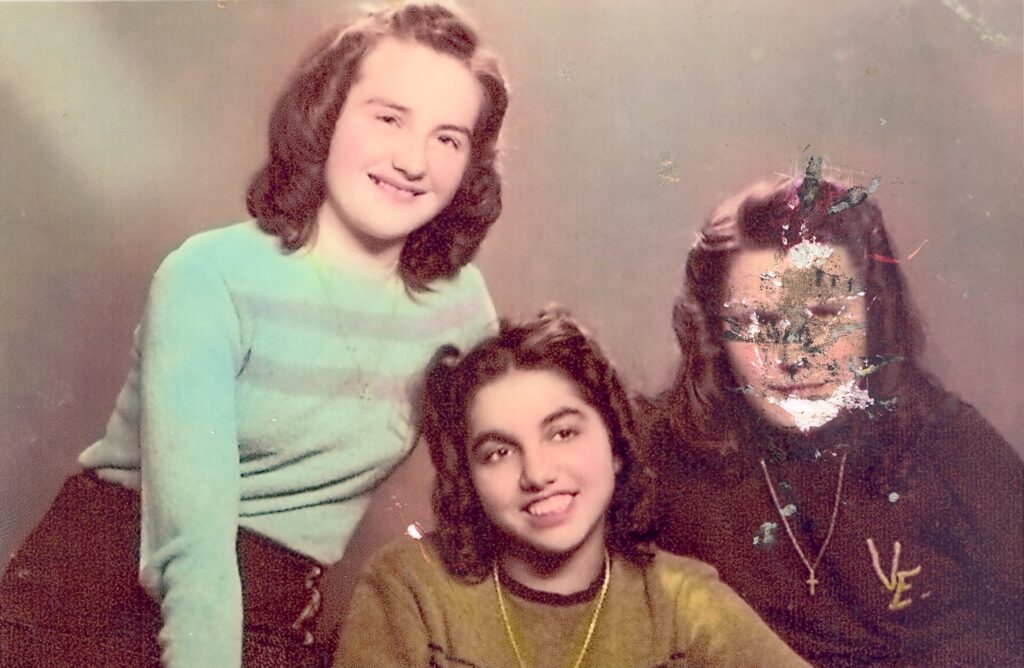
On the evening before the announced deportation of their relatives in March 1943, Emílie and her parents set off for Svatobořice to say goodbye to the family before their uncertain journey. At that moment, neither Emílie nor her closest relatives knew their ultimate fate. When they arrived at the home of Uncle Štěpán Holomek (1905–1943), they found his non-Roma wife Cecílie (1907–1985) there. Emílie later often recalled this scene with deep emotion:
“Auntie was sitting in the kitchen, staring into space. Her hair was grey. She had turned grey from the pain, the horror and the fear.” Meanwhile, in the bedroom, Uncle was saying goodbye to his young children, the youngest of whom was just three years old. “The children were lying side by side. Uncle was already dressed. It’s been so many years and I can still see it and I dream about it… One by one, he made the sign of the cross over them, stroked them, kissed them, and that’s how he said goodbye to the children. The children were terrified; they didn’t know what was happening. I hugged my uncle, kissed him and ran away. And that was the last time I saw him.” 4
Emilie then hurried to the other end of Svatobořice to her uncle Čeněňek Holomek (1915–1943). He was the only one of his brothers to have a Romani wife, Emílie, known as Milena (1915‒?), and they were therefore to be included in the transport together with their three-year-old daughter Růženka (1939‒1985). At this point, the story took a decisive turn. She was no longer just a teenage girl facing the same persecution as her family; she spontaneously stepped into the story and decided to take action. “I said: ‘Don’t take Růženka away from me, I’ll take her home.’” Together with her uncle, aunt and little Růženka, they then went to the railway station. According to Emílie’s recollections, the stationmaster seemed to sense what was happening and delayed the train’s departure so that the family could say their goodbyes:
“It was awful. Milena was crying. Both of them were holding Růženka, stroking her and kissing her, but she wanted to come to me because they’d told her she’d be coming home with me. And we got into the carriage, opened the window, and waved. Milena was crying her eyes out; I tried to hold it together, but the tears were streaming down my face too. And that was the last time Růženka saw her parents, and they saw Růženka.” 5
These words also show that this was an experience which remained with her not merely as a memory, but as a long-lasting and recurring traumatic image.
After arriving in Nesovice, little Růženka found the separation from her parents very hard to bear. “When we took her in, she cried and cried. … She came down with rheumatic fever. The doctor said she should be in hospital, but she couldn’t, because she was due to be sent to a concentration camp. She suffered from heart problems her whole life and died of them at the age of forty-six. But she did survive, after all…” 6
Yet Růženka’s rescue did not mean she was spared the consequences of Nazi persecution. The very act of being forcibly separated from her parents, along with the prolonged fear and uncertainty, took an immediate toll on her health and, according to Emílie’s account, a lasting one. Her story thus shows that Nazi policy affected not only those who were deported and murdered, but also those who, whilst physically surviving, bore its consequences for the rest of their lives.
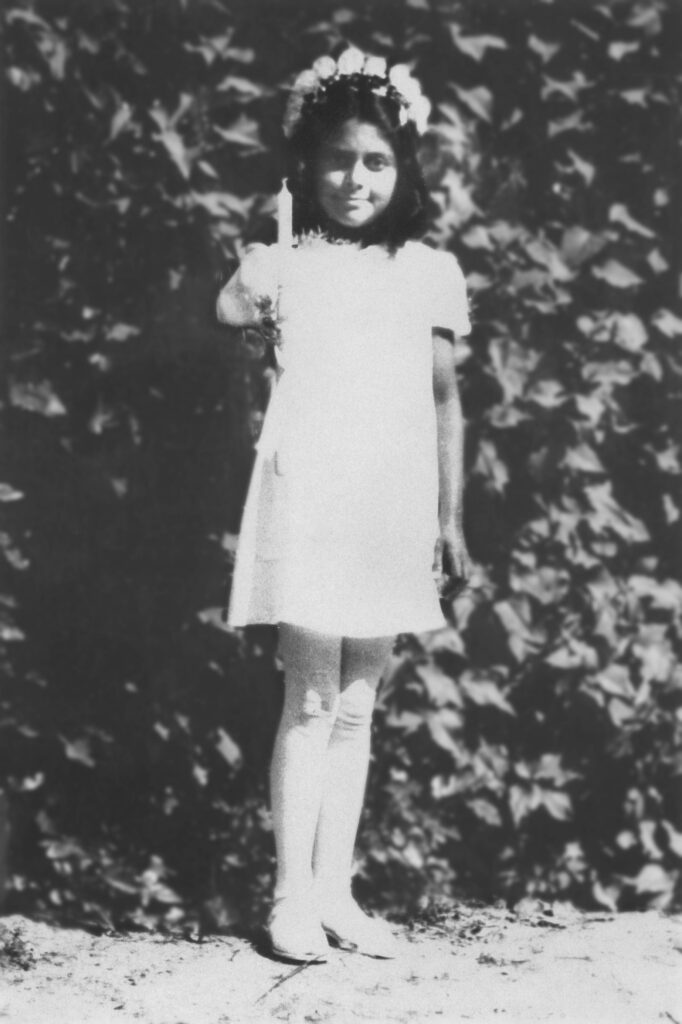
The family’s situation remained extremely dangerous. Although the Holomeks were not deported to a concentration camp, they were not allowed to travel more than twenty kilometres from their home and were under constant surveillance by the authorities and the Gestapo. It was all the more risky that, along with Růženka, they were also hiding their grandmother Terezie (1873‒1966) from deportation in their house in Nesovice. Emílie recalled:
“Whenever the Gestapo came, for instance, we’d get a heads-up. And we had this little room there; we put Růženka and the old lady in that room and placed a wardrobe in front of it. They came to search the garden, the yard and the pigsty, but they didn’t realise there was someone behind that wardrobe. Růženka was told: ‘You must be quiet.’ And she was quiet.” 7
This was not a one-off gesture, but a situation maintained over the long term, which for many months required perseverance, caution, discipline and the ability to function under the constant threat of discovery. Despite the constant danger, the family managed to hide both the grandmother and little Růžena, who even at such a tender age had to submit to discipline and silence as a condition of her own survival, until the end of the war, thus saving their lives.
However, this was not the only help the Holomeks provided in their small house in Nesovice. In the summer of 1944, her cousin Eduard, or Eda Holomek (born 1922), arrived from Kyjov, having escaped from forced labour and imprisonment in Austria. As Emílie recalled, “He found no one left at home; he had five siblings, his parents and two nephews there. They had all been taken to a concentration camp and their house razed to the ground. Eda secretly brought home a female prisoner of war from Greece. She was 18 years old. … So there were four people in hiding at the Holomeks’ in Nesovice, but they survived thanks to all the residents of the village of Nesovice.” 8
However, it was not only the solidarity of the local community that contributed to the rescue, but above all the daily dedication, courage and self-sacrifice of the entire Holomek family. Emílie herself also played a significant role, actively participating in the hiding and, as a teenage girl, consciously bearing part of the associated risk.
By doing so, however, the Holomeks were not only putting themselves in danger. Under the conditions of Nazi occupation, the discovery of those in hiding could have meant severe punishment not only for the family, but potentially also for a wider circle of local residents. Moreover, repeated ‘visits’ from the Gestapo were certainly not welcome in the village as such and in themselves posed a security and existential risk to the local community. This makes it all the more important to acknowledge the help and solidarity that some of the residents of Nesovice provided to their Roma fellow citizens despite the present risk. In an environment where even the slightest suspicion could trigger repressive action by the occupying authorities, this support was a crucial factor in ensuring that the hiding could be kept secret for so long.
In addition to the threat of deportation, daily persecution and the risks associated with hiding relatives, Emílie also had to face another, particularly intimate form of Nazi violence – forced sterilisation. As she later recalled, another decisive moment in her life came in the summer of 1944. “At home, I had a letter from the Brno Gestapo stating that I was to report to a certain hospital at a specific time, where I would be sterilised so that no more members of the ‘inferior Gypsy race’ would be born. I didn’t know what sterilisation was, so I hid the letter and didn’t show it to anyone. I cried; I cried all the time.” 9
At this moment, her young age and her helpless position vis-à-vis the occupying power are fully revealed. The threat of forced sterilisation represented a particularly radical form of Nazi racial policy. It was not merely another repressive measure, but a direct violation of her bodily integrity, her female identity and her future, as it targeted the very possibility of motherhood.
Emílie confided in the director of the factory where she worked, and on his advice, she decided to avoid the procedure. From August 1944, she therefore went into hiding in Olomouc-Hejčín, in the cellar of a terraced house where her distant relatives lived. Meanwhile, in Nesovice, it was officially stated that she had left for forced labour in Germany. Only the village mayor, the commander of the local gendarmerie station and her immediate family knew the truth. Emilie spent this time in fear and separation from her loved ones: “I was hidden there for about four and a half months. I just cried and cried there… That’s how I survived…” 10
Only a few members of Emílie’s extended family survived to see the end of the war. Her uncle Tomáš Holomek, who had been hiding with friends during the occupation, his non-Roma wife and children, and her cousin Eduard Holomek, who had been sent to work in Austria, all lived to see liberation. As Emílie and her family learned after the war ended, all the other relatives who had been deported en masse perished in concentration and extermination camps. For Emílie and her loved ones, the end of the war did not mean a return to their former lives, but rather the beginning of a new existence against the backdrop of an irreplaceable family loss. Survival came at the price of knowing that a large part of the extended family would never return.
Emílie soon married Jan Machálek, whom she had known from Nesovice. Before completing her own studies, she chose family life and became the mother of four children. For most of her working life, she worked as a sales assistant in a butcher’s shop. Her brother, Doc. Ing. RSDr. Miroslav Holomek, CSc. (1925‒1989), on the other hand, pursued an academic career after the war, working in Brno as a university lecturer and as the founder and chairman of the Union of Gypsies-Roma. This life path also reveals a different aspect of post-war reconstruction. Whilst her brother continued his studies and public career, Emílie initially built her life primarily around family and motherhood. This was not a less significant path, but a different way of rebuilding everyday certainties and a sense of security after the experience of the war.
Emílie Machálková’s lifelong passion was singing. Her interpretations of traditional Romani songs earned her considerable acclaim and she became a well-known Romani singer. She won several singing competitions and performed regularly in public, including with the famous Romani bandleader Eugen “Janko” Horváth and his cimbalom band. Her repertoire also included the so-called lament “Aušvicate hi kher báro” (There is a big barrack in Auschwitz), originally sung in the camp for Roma and Sinti within the Auschwitz-Birkenau extermination camp. It was here that Emílie expressed herself not only as a singer, but also as a bearer of cultural memory. Through her songs, she preserved in her public performances the memory of the Holocaust of the Roma and Sinti, which had a deeply personal dimension for her, as it was in Auschwitz that most of her relatives perished.
Emílie Machálková summarised her life experiences in the memoir “Elina – The Saga of the Holomek Family”, which appeared in 2004 in the publication “Memoirs of Romani Women” issued by the Museum of Romani Culture. Her account also became part of the collection of eyewitness testimonies “Memory of the Nation”, managed by the Post Bellum organisation. She also began to devote herself intensively to lecturing and publicly sharing her experiences, particularly as part of the Living Memory project. Primarily through the project “The Disappeared Roma and Roma Today”, implemented by the organisation Living Memory (Živá paměť), she has visited dozens of primary, secondary and higher education institutions across the Czech Republic since 2005. Thousands of listeners have heard her testimony about her family’s fate and life during the Second World War. Emílie was thus not only a witness to history, but also an active bearer and communicator of historical memory.
She received several awards for her work. In 2012, she was awarded the Václav Benda Prize and the Institute for the Study of Totalitarian Regimes’ Commemorative Medal “For Freedom and Democracy”; in 2013, she received the Jaromír Šavrda Prize for testimony on totalitarianism, awarded by the PANT association, and in the same year also the Roma Culture Museum Prize.
Emílie Machálková died on 16 July 2017 at the age of 90.
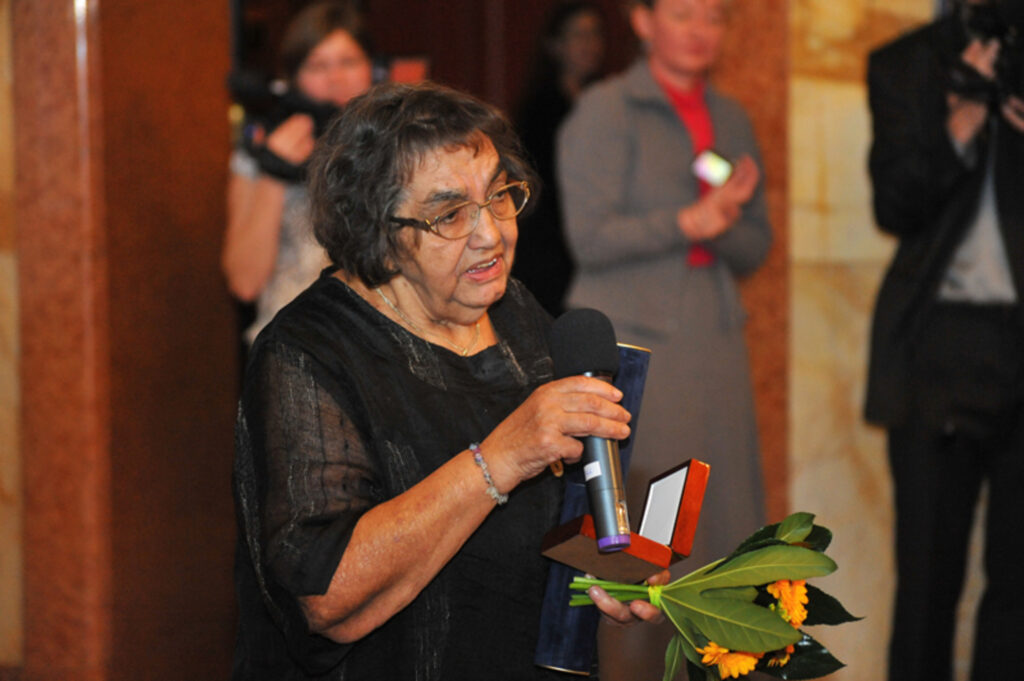
The story of Emílie Machálková illustrates, on a personal level, just how multifaceted and often subtle resistance to Nazi racial policies could be. Emílie was not merely a passive witness to the persecution. In an environment of daily danger, together with her family and with the help of the inhabitants of Nesovice, she played a part in rescuing her closest relatives, took the risks involved in hiding them, and ultimately consciously avoided the compulsory sterilisation. During the occupation, the teenage Emílie Machálková thus repeatedly found herself in situations where she actively contributed to the rescue of others whilst facing direct danger herself. Her decision to avoid the medical procedure and go underground was not merely an attempt to escape immediate danger, but also a conscious refusal of an intervention that was to decide the fate of her body and future against her will. It was in this sense that it constituted a specific form of female resistance to Nazi racial policy. Her story serves as a reminder that resistance to injustice does not always take the form of public action or open struggle, but can also unfold in everyday, seemingly minor decisions which, taken together, save human lives. This is why the story of Emíliea Machálková and her family holds an important place in the history of the Roma and Sinti and their Nazi genocide, but also in the broader remembrance and collective memory of mainstream society as an inspiring testimony to civic courage. Emílie Machálková’s wartime experience is, in fact, one of the most eloquent examples of civil resistance and defiance (not only) by Romani women during the period of Nazi persecution, and her story remains as relevant today as ever.
As Emílie Machálková herself once wrote at the end of her memoir:
“If a person wishes to achieve something through diligence and honesty, it does not matter whether they are white, black or yellow. Every person has a bit of evil and a bit of good within them, and it is up to each individual to decide which will prevail. When everyone is tolerant, self-critical, and able to distinguish truth from lies and justice from evil, the world will be a better place. And may God help us to achieve this!” 11