Sign up to our Newsletter!
Růžena Danielová’s life story is one of those personal testimonies of the Holocaust that are hard to forget – if we can bring ourselves to read them to the end…
The difficult but peaceful life of Růžena Danielová and her family was fundamentally disrupted by World War II and the Nazis’ racist rampage, which culminated in torture and murder in the concentration camps. Her fate is documented in official records, postwar memoirs, scholarly works, and film and radio recordings. A special place in this narrative is occupied by the song “Aušvicate hi kher báro,” which she sang while imprisoned at Auschwitz-Birkenau and which later became one of the most famous musical testimonies and a symbol of the Nazi persecution of the Roma and Sinti.
Růžena Danielová, née Malíková, was born on February 27, 1904, in Čejč in the Hodonín region. Her mother was Alžběta Malíková, a single mother and the illegitimate daughter of Marie Malíková from Dubňany. Růžena’s childhood was spent in South Moravia, primarily in villages in the Hodonín region. According to her own account, as a child she wandered with her blind mother through the local villages of Hovorany, Čejkovice, and Terezín, though they most often stayed in Mutěnice, where they lived with various people. Her mother’s sisters married and moved to western Slovakia, specifically to Kopčany and Skalica; one of her uncles may have lived in Holíč. 1
From the age of sixteen, Růžena Malíková lived with Martin Daniel, born on June 12, 1900, in Lechovice in the Znojmo region as the illegitimate son of Barbora Danielová. All we know about the early days of their life together is that between 1920 and 1927 they lived in Kobylí in the Břeclav region, along with another family in a company-provided (employee) house belonging to what was then the Slavíček Brickworks, located on the Úlehly road between Kobylí and Čejkovice. When Hubert Slavíček from Čejč bought the brickworks in the early 1920s, it was just a small, artisanal operation. In the years that followed, he managed to expand and mechanize it, increasing production from approximately 70,000 bricks per year to about half a million. 2 Růžena Malíková and her partner Martin worked in brick production, and according to eyewitness accounts, they were very hardworking: they loaded clay, cut it, and passed it onto trays for further processing. Martin also worked as a security guard at the factory. 3 Martin and Růžena were not married until June 29, 1926, in Kobylí. 4 The couple’s first children were also born in this village. Their son František was born on July 7, 1921, but died on May 11, 1922. He was followed by Jan, born on February 25, 1923; Magdaléna, born on February 22, 1925; and Tomáš, born on March 7, 1927. 5
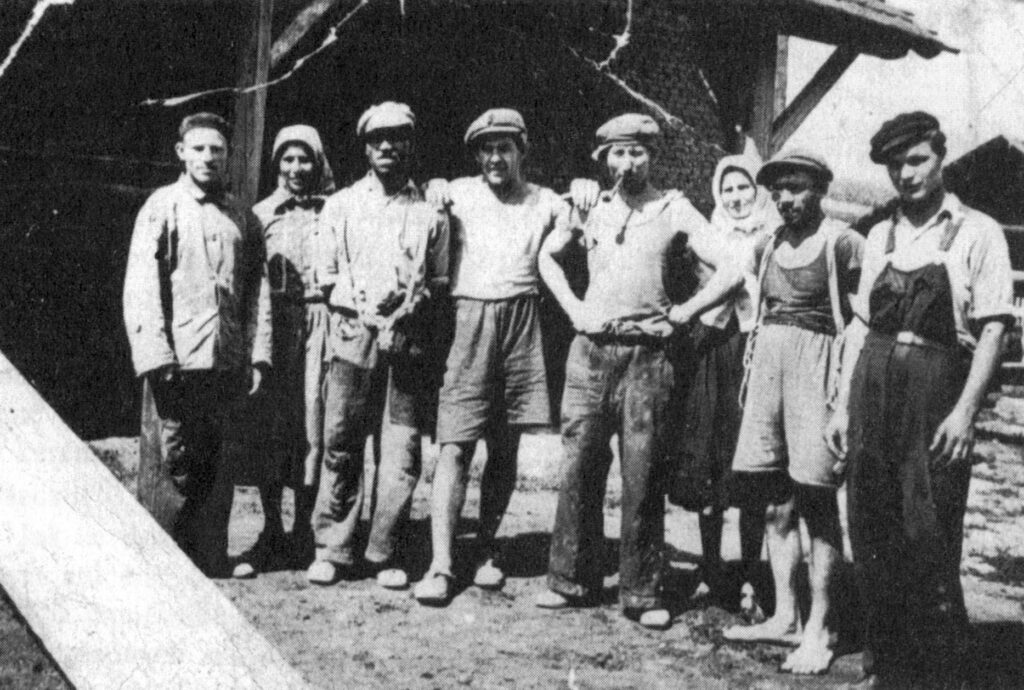
In 1927, the entire family moved to Břeclav, where they remained until 1938. They lived in a small settlement called Genža, located near the town by the railroad tracks and what were then Lesní and Lanžhotská Streets. It consisted of four makeshift houses without street numbers, identified only by Roman numerals. Here, too, the Daniels worked primarily at the brickworks in neighboring Poštorná (now part of Břeclav). The 1930 census record also lists Martin Daniel as a laborer at the municipal building authority. Their twins, Zuzana and Michal, were born in Břeclav on February 11, 1932. Růžena’s mother, Alžběta, also lived with the family until her death in 1935. 6
Another major change for the Daniels came in the late 1930s, when the brickworks in Poštorná closed and they had to look for work elsewhere. They succeeded and soon found permanent employment at the municipal brickworks in Mutěnice. Their eldest son, Jan, was already working there, but he soon left – along with some other boys from Mutěnice – to find work in Linz, Austria. In addition to her work at the municipal brickworks, Růžena also took care of her own household and worked as a servant for local families in the area. She would go with her older children to help with threshing grain, during the grape harvest, and with other farm work. For this help, they received not only money but also payment in kind. In Mutěnice, they initially lived again in a company-provided dwelling at the municipal brickworks. In 1940, however, they built their own family home, which had two living rooms and a spacious porch with a small kitchen. The house did not differ in quality or furnishings from the dwellings of other poorer villagers. As official documents show, Martin and Růžena Daniel could neither read nor write, yet they wanted a better education for their children. While their eldest son, Jan, attended one of the elementary schools in Břeclav, the other children continued their schooling or began it in Mutěnice. 7
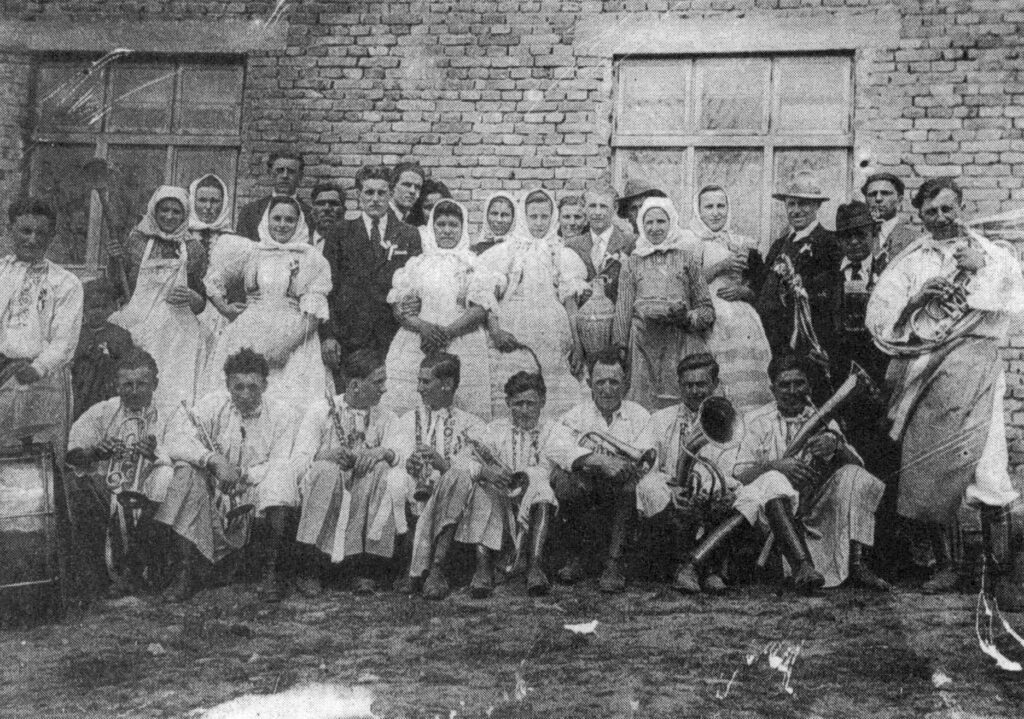
The residents of Mutěnice accepted Růžena and Martin Daniel as a hardworking and law-abiding couple who took good care of their children and maintained normal neighborly relations. 8 After World War II, Růžena herself emphasized that she was well accepted in Mutěnice and that she participated in local social life, including balls, village fairs, and other celebrations:
“People liked us. I don’t know, people didn’t shun us. Never! No matter how many balls there were, I had an invitation to every one. And I was always part of the crowd. […] People liked me very much.” 9
In another recollection, she stated:
“In Mutěnice, they didn’t treat us like Gypsies. Never in my life! […] No one ever hurt us! No one here ever called me ‘Růžena the Gypsy.’” 10
Jan Kratochvíla (1887–1950) was a prominent and respected figure in the community life of Mutěnice at the time. He was a cottage owner, road worker, and local official who also served as mayor for the Social Democratic Party from 1919 to 1920 and from 1932 to 1945. 11 Růžena Danielová recalled him in very personal terms:
“We were as close as two peas in a pod with him – the mayor. It was as if my Majduša were their daughter. Whether it was a hunt, a feast, a celebration, or a wine competition, I was there every time! […] Oh, how I danced with him!” 12
After the establishment of the Protectorate of Bohemia and Moravia, the Daniels, along with other individuals and families whom the Protectorate authorities labeled as racial “Gypsies” or “Gypsy half-breeds,” became targets of Nazi persecution and genocide, even though the anti-Roma measures of the early years of the German occupation initially left them largely untouched. This changed radically in 1943, when, based on the so-called Auschwitz Decree (available in Czech) issued by Heinrich Himmler, head of the German police and the SS, on December 16, 1942, mass deportations of Roma and Sinti from the Protectorate to the Auschwitz-Birkenau concentration and extermination camp began. 13
The Daniel family, too, was taken in March 1943 to the train station in Strážnice, where Roma from Mutěnice and surrounding villages destined for transport were being rounded up. Růžena Danielová later described it as follows:
“So in ’43, we got a notice from the village that something was being planned, that they were going to take us somewhere for two months; that’s how they explained it to us. And they rounded us up. They took us to Strážnice – all of us, including the children. From Strážnice, the municipality took us back to Mutěnice. Then I think it lasted – I’m not sure if it was six weeks – and then they rounded us up again and took us straight to Osvěnčín.” 14
Her recollection illustrates not only the uncertainty in which the family lived, but also the fact that the initial transfer to Strážnice did not yet result in deportation. The Daniel family’s return to Mutěnice was most likely the result of intervention by local municipal officials, who attempted to vouch for the family. Similar, albeit rather isolated, efforts by local officials to save individual Romani people and families are also documented in several other Moravian villages, such as in the case of the Dycha family in Hrušky in the Břeclav region 15 or in the case of the family of Emílie Machálková (available in English), née Holomková, in Nesovice in the Vyškov region.
However, the hope for rescue did not last long. After a few weeks, the operation was repeated, and this time the German criminal police did not accept the guarantees offered by the local officials. Thus, the Daniel family was immediately placed on the next scheduled transport in May. In the final weeks before the deportation, the family attempted to save at least their eldest daughter, Magdaléna, by marrying her off to her non-Roma partner, Zdeněk Adamec from Velvary, who was working as a farm laborer in Mutěnice at the time. According to Růžena Danielová’s recollection, people in Mutěnice encouraged this mixed marriage in the hope that Magdaléna would not be included in the transport and that it might even help the entire family. However, this did not prevent the deportation, and Magdaléna, who was already pregnant at the time, was placed on a mass transport along with her parents and siblings, while her new husband, Zdeněk Adamec, remained in the village. 16
Before their forced departure from Mutěnice, Martin Daniel asked Mayor Jan Kratochvíla to entrust their house to a trustworthy person while they were away; thus, during the war, police officer Bednařík and his family lived there. According to Růžena’s recollection, the mayor also tried to help the family as they were leaving the village: when the Daniels were leaving Mutěnice, he brought them mulled wine and five loaves of bread for the journey. According to later findings, Jan Kratochvíla tried to protect a number of local residents from persecution and imprisonment during the occupation and did everything in his power for the Daniels. However, in the face of Nazi deportation policies, local solidarity and personal intercession were of no help, and so, in early May 1943, the Daniels were escorted to a roundup point in Hodonín. 17
The mass transport carrying the Daniel family, which departed from Brno and included over 850 men, women, and children, arrived at the Auschwitz II-Birkenau concentration and extermination camp on May 7, 1943. 18 Růžena Danielová, her husband Martin, and their children Jan, Magdaléna, Tomáš, Zuzana, and Michal were interned in camp section B-II-e, which the Nazi administration designated as the “Zigeunerlager”, so-called “Gypsy camp” (available in Czech). Approximately 23,000 Roma and Sinti were gradually imprisoned in this section of the camp, most of whom also died there. Unlike in other parts of the Auschwitz complex, men, women, and children were not separated immediately upon arrival. However, keeping families together did nothing to change the fact that male and female prisoners were subjected to systematic violence, starvation, disease, pseudo-medical experiments, forced labor, and gradual physical extermination. 19
As Růžena Danielová recalled after the war, the brutal treatment began immediately upon disembarking from the transport:
“You know what it was like at that train station, what it looked like. Whether it was a stick or a slipper – well, whatever they happened to have in their hands – they beat each and every one of us.”
The new arrivals were lined up in groups of five and, under constant beatings, driven into the camp section. Members of the guard units used whatever they happened to have in their hands – sticks, shoes, or the handles of work tools. Růžena’s son Tomáš had a broken arm upon arrival, Jan had a head injury, Růžena was beaten on the legs, and her husband was beaten all over his body. 20
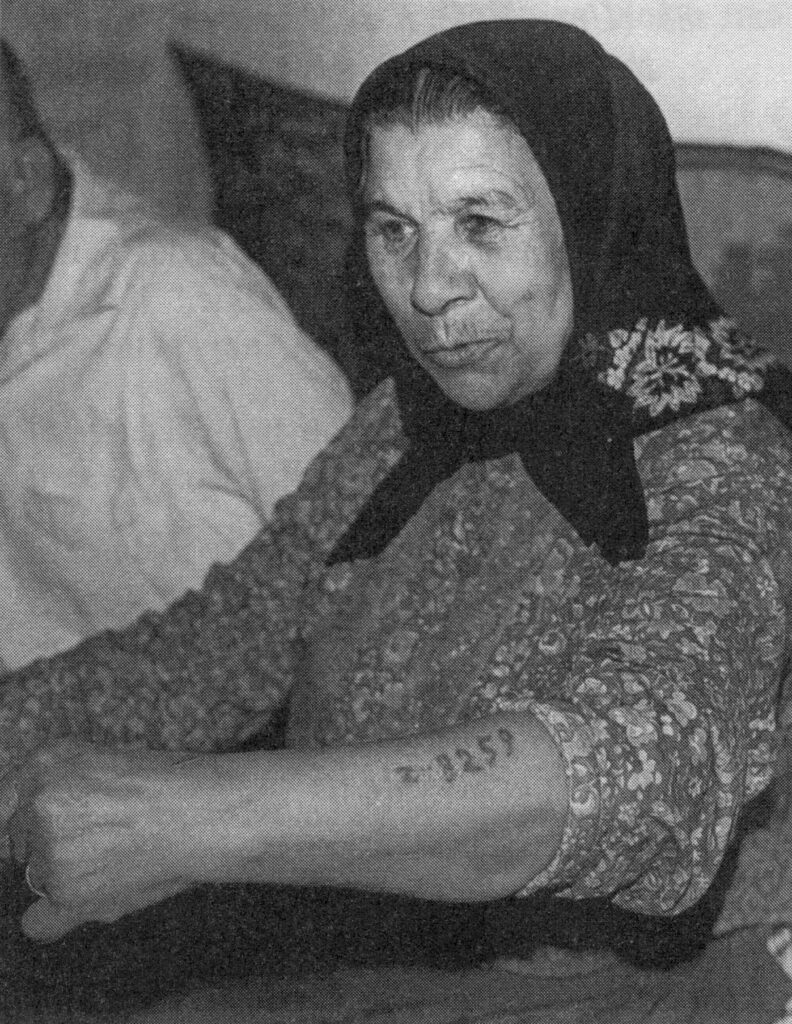
The battered people spent their first night crammed into a filthy block with a floor covered in excrement. There, they were registered and tattooed with prisoner numbers. Martin Daniel was given the number Z-7569; his sons Jan received Z-7570, Tomáš Z-7571, and Michal Z-7572. Růžena Danielová was tattooed with the number Z-8259; her daughters Magdaléna received Z-8260 and Zuzana Z-8261. 21 The letter Z, derived from the German term “Zigeuner,” became part of their camp identity. During the intake procedure, male and female prisoners were stripped of their clothing and all personal belongings and given worn-out, often lice-infested clothes and clogs left behind by the deceased. 22 When the prisoners were being divided into individual blocks, Daniel and his family tried to stay together: “We always squeezed in one after the other – the whole family, so we’d all be together.” 23 And although they succeeded and were placed together in Block 8, it did not help them avoid the conditions that prevailed in the overcrowded wooden barracks. The prisoners lay crammed onto bare wooden bunks without straw or blankets in barracks originally intended for stabling horses. Růžena Danielová recalled how the situation worsened as autumn set in:
“We lay on those planks – there were eight of us. There was a heavy frost, and our bodies froze to the planks. They were like stables, or whatever they were. So our flesh froze to those planks; whenever you turned over, your flesh would stick there.” 24
Daily life in the camp was marked by hours-long roll calls, beatings, forced labor, hunger, and constant uncertainty. The prisoners had to line up for roll call at least twice a day, regardless of the weather, their health, or their age. When they weren’t assigned to work, they were often at least driven outside and forced to stand on the “roll call square.” Any sign of weakness, failure to obey an order, or attempt to obtain something to eat could be punished with brutal beatings. Many work tasks lacked any practical purpose and served primarily to exhaust and humiliate the prisoners. Among other things, Růžena Danielová described how women carried large containers filled with stones on their shoulders and worked barefoot, inadequately clothed, and hungry in muddy terrain. 25
The food was completely inadequate in both quantity and nutritional value. Male and female prisoners were given a few potatoes, thin nettle soup, beet tops, or other scraps, which were often dirty, spoiled, and infested with rodents. Even more serious was the lack of drinking water. Initially, running water was available only in the kitchens and later in the washrooms and the infirmary; however, water was supplied only sparingly and, moreover, was unfit for consumption. Prisoners were often unable to even wash themselves, and attempts to drink or perform basic hygiene were frequently met with harsh punishment. 26 After the war, Růžena Danielová also recalled the medical experiments she was subjected to in the camp. Along with other women, she was taken to the hospital block, where her eyes were covered, she was repeatedly beaten, and she was subjected to painful procedures on her head and other parts of her body. She described being pricked with a thick needle, the development of a festering swelling, and the excision of a piece of tissue from her hand, into which an unknown substance was subsequently to be injected. On another occasion, she and other female prisoners were locked in a small room where she had to endure unbearably high temperatures. 27
Amid widespread starvation, Růžena Danielová tried to obtain any food she could, especially for her children. In one of her memoirs, she described how she collected scraps of beets, cabbage, and cucumbers from under the latrines, hid them under her clothes, and took them to her children. During one such attempt, a member of the camp staff caught her, brutally beat her, and kicked her. Nevertheless, she brought the scraps back to the barracks and divided them among her children:
“I shook the little peels off and put them right into each of their mouths so they’d last longer, poor little things.” 28
Hunger, thirst, filth, lice, physical violence, and extreme psychological stress led to the rapid spread of disease. The incidence of illness in the Romani camp rose sharply, particularly in the summer of 1943 and again during the winter of 1943–1944. Sick prisoners were often left without adequate treatment, hygiene, or basic care. These inhumane conditions also affected the fate of the Daniel family. Martin Daniel was the first to die in August 1943, 29 who, according to Růžena’s account, did not return from work one day. In September 1943 (according to other sources, as late as February 1944), Zuzana died, 30 followed by Jan in December 1943, 31 then Magdaléna 32 and Tomáš. 33 Michal was apparently the last to die, but the exact date of his death is unknown.34
Růžena Danielová later described her last encounter with Michal:
“So now they’ve taken my last two children. Well, they took them somewhere – they called it a ‘revír,’ which is German for ‘krankenbau,’ and they called it a ‘revír’ – it was like a sickbay. And then some woman told me that he was in such-and-such a block and that he was calling for me. […] And I was already crawling under that wire – the whole place was fenced off, but it wasn’t electrified; there was just that wire there. So I slipped a board under it, pried it open, and made my way to the gate, to the door leading to that block. And then that old man called out: ‘Which one of you here is Michal?’ […] Well, and now he’s coming toward me through the block; I’m walking, and he says to me: “Mommy, they’ll kill you – don’t come here!” Poor thing – naked, covered in scabs, all scabby – and he grabbed me: “Mommy, I want to go home.” “How can you,” I said, “Mišánek, go home?” “I’d like some water, Mommy, I’d like something to eat – I’m hungry, I’m sick.” He had a fever, poor thing! And then someone chased us away – I don’t know who it was, some young man chased us away – and I had to pull myself together and leave. He, too, poor thing, left. And I never saw him again. I haven’t seen any of my children since then.” 35
When the Nazi leadership decided in 1944 to liquidate the Romani camp at Auschwitz II-Birkenau, the male and female prisoners who were fit for work were gradually transported to other concentration camps, while the remaining men, women, and children – numbering approximately 4,300 – were murdered in the gas chambers on the night of August 2–3, 1944. On August 2, 1944, Růžena Danielová was placed on the last transport of women to the Ravensbrück concentration camp, 36 where she was assigned prisoner number 48,715. 37 After several weeks, she was transferred from Ravensbrück to a subcamp at the Arado Flugzeugwerke factory in Wittenberg, where the female prisoners were put to work in aircraft production. The camp was originally administratively subordinate to the Ravensbrück concentration camp, but at the end of 1944, along with several other women’s satellite camps, it came under the administration of the Sachsenhausen concentration camp, which until then had been reserved exclusively for men. 38 According to her later memoirs, Růžena Danielová remained there until the end of the war. During the final weeks of her imprisonment, she witnessed the gradual departure of the female guards and the collapse of the camp administration. After leaving the camp following its liberation, she set out on foot with other female prisoners toward the Czechoslovak border. She suffered from frostbite on her feet, knees, and other parts of her body, and according to her own account, she walked for several weeks, mostly at night. After crossing the border, she managed to reach Přerov and subsequently made it home. 39
When she arrived in Mutěnice in late May 1945, the family home that she and her husband had built there before the war was still occupied by police officer Bednařík and his family. Růžena found refuge with them for three months. Since none of her closest relatives had returned, she initiated official proceedings to have them declared dead, which occurred following an investigation based on a ruling by the District Court in Hodonín in September 1946. Their names and dates of birth and death are listed on a memorial in Mutěnice commemorating the victims of World War II from that village. 40
The consequences of her imprisonment in the camp haunted Růžena Danielová for the rest of her life. In 1968, she was granted full disability status in connection with Nazi persecution. The depth of her trauma is also evident in her recollection of a trip by former anti-fascist fighters to Auschwitz in 1966:
“As we were traveling from Auschwitz to Birkenau, my head started pounding; I jumped out of the bus – I wanted to kill myself right there. At the very spot where my children had perished. That’s where I wanted to kill myself. But I couldn’t… I don’t even want to hear about Auschwitz anymore!” 41
In the postwar years, Růžena Danielová married violinist Pavel Kubík (1902–1982), who came from a Romani musical family in Hrubá Vrbka in the Horňácko region. His younger brother was the bandleader Josef “Jožka” Kubík (1907–1978), one of the most prominent figures in Horňácko folk music. The Kubík family was also severely affected by anti-Roma persecution during the Nazi occupation; however, in 1943, both brothers, along with several others, were spared from the ongoing transports to concentration camps and thus survived.42
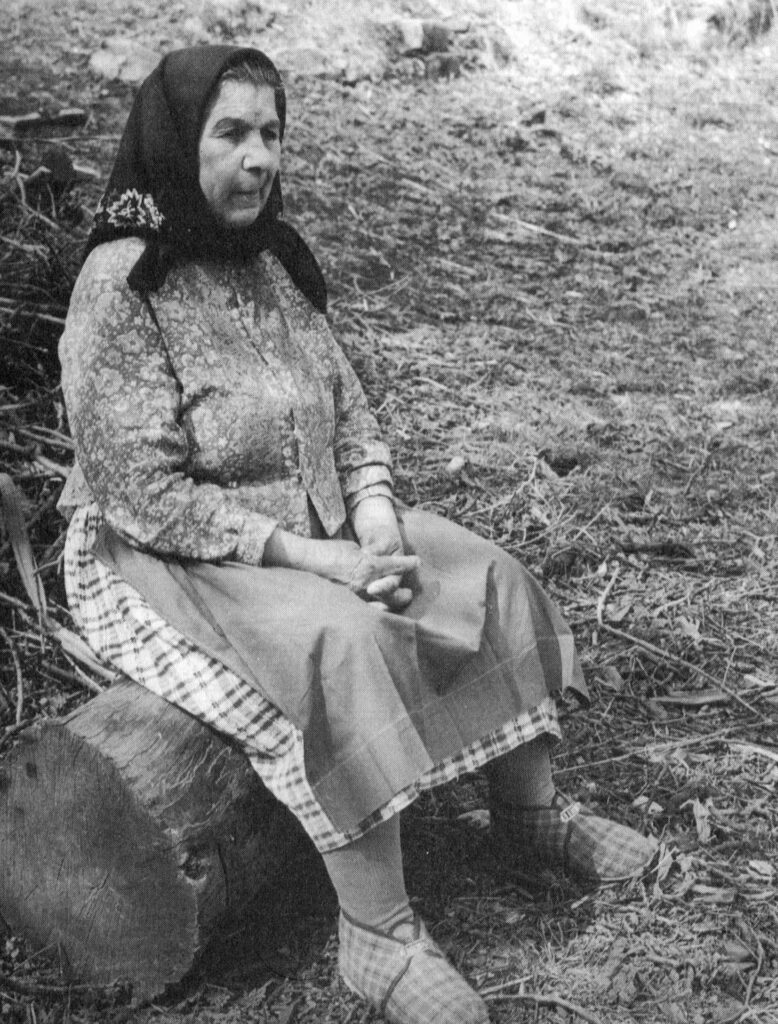
Růžena Danielová and Pavel Kubík lived together in Mutěnice, Hodonín, and also in Hrubá Vrbka. Toward the end of her life, Růžena Danielová lived in a retirement home in Hodonín. Ethnologist and musicologist Dušan Holý wrote in an obituary published in the newspaper Lidová demokracie (English People’s Democracy): “She recently had the misfortune of breaking her leg, so I visited her in the hospital and perhaps managed to cheer her up for a moment, so she opened up. But otherwise, she made it clear that her greatest desire was to pass away – in her own words: to go where her children have been for so long.” Růžena Danielová died on May 3, 1988, at the age of eighty-four, in a hospital in Hodonín, and is buried in the town cemetery there. 43
One of the most significant testimonies that has survived from the Nazi concentration camps is the Romani song “Aušvicate hi kher báro” (in English “In Auschwitz there is a big prison”), also known simply as “Aušvicate” (in English “In Auschwitz”). It belongs to the so-called lament songs, in which Romani and Sinti people captured their experiences of persecution, internment, and camp violence. Songs about the suffering during World War II were often set to the melodies of older Romani folk songs. Their lyrics were passed down orally, evolving according to the experiences of individual singers, and referred to various internment, labor, and concentration camps. Singing not only provided the prisoners with temporary relief from fear, pain, and despair, but also helped them maintain mutual solidarity, a sense of belonging, and their own human identity. In situations where speaking was prohibited – for example, during roll calls – improvised songs could also serve, to some extent, as a means of communication. Singing in their own language simultaneously represented a form of resistance against demoralization and the Nazi system, which sought to strip the prisoners of their individuality.
The song “Aušvicate hi kher báro” was likely created as a collectively composed and shared work at the Auschwitz-Birkenau concentration and extermination camp, set to the melody of the old Romani song “Oda kalo čirikloro” (in English “That Black Little Bird”). In scholarly literature, it is classified as a camp song in the strictest sense, as it was created and sung directly at the Auschwitz concentration camp, and its lyrics captured the specific conditions of imprisonment there. At the same time, this song became a means of orally transmitting these experiences to the outside world and to future generations. It did not have a fixed form and circulated in various versions, which were recorded after 1945 in Polish, Moravian, and Slovak contexts. The Slovak versions also linked the original motif to Dubnica nad Váhom in western Slovakia, where a labor camp and later a Romani internment camp were located during World War II. 44
Růžena Danielová apparently adopted the melody and basic motifs of the song, which were already circulating among the prisoners, and reworked them into her own version reflecting her specific experience. According to her own account, she sang the song in the camp in the evenings together with the blind accordionist František Daniel from Oslavany and his wife. 45 The most significant early recording of the song took place in April 1957, when a celebration of bandleader Jožka Kubík’s 50th birthday was held in Hrubá Vrbka. In front of the gathered well-wishers, Růžena Danielová explained the circumstances under which she had sung the song and recited its Romani lyrics. Given the presence of staff from Czechoslovak Radio Brno, her performance was recorded on tape. In her introduction, Růžena Danielová stated:
“I must tell you, distinguished guests, why I want to sing this song and why I want it to be known to audiences around the world: I was imprisoned for two years, and that song – when I was receiving the worst beatings – the flesh was falling off my knees, the same from my elbows, and my spine remains broken to this day – during those most brutal beatings, I composed this song that I’m going to sing for you; I’m not sure if I’ll be able to finish singing it, or if I’ll start crying.” 46
The song “Aušvicate hi kher báro” is a lament over separation, hunger, and helplessness. The song’s personal dimension intertwines with the collective experience of the prisoners – grief over love and family transforms into a testimony about the living conditions of the entire community. The Auschwitz concentration camp appears in the song as a vast prison where the singer’s beloved is confined and lamenting. Subsequent verses speak of food shortages – the prisoners having not even a crumb of bread – and of the violence perpetrated by camp officials.
Some interpretations also explain part of the lyrics as an indirect reference to sexual violence against female prisoners. At the same time, the song contains a distinct element of anger and defiance, which resonates most strongly in the final cry: “When I finally go home, I’ll kill the block elder.” In the context of the song, this verse can be read as a desire for retribution sparked by extreme camp violence. Like other songs composed in concentration and other internment camps, it is not merely a lament over suffering and death, but also an indictment of the perpetrators and a refusal to submit completely to camp violence. 47
In the 1970s, composer and musicologist Miloš Štědroň was introduced to the song “Aušvicate hi kher báro” by ethnologist and musicologist Dušan Holý. Together with composer Arnošt Parsch, he used its melody as the basis for a composition for viola and the Brno Radio Orchestra of Folk Instruments (in Czech Brněnský rozhlasový orchestr lidových nástrojů or BROLN) titled “A Lament of Růžena Danielová from Hrubá Vrbka for Her Husband in Auschwitz.” The composition was written in 1975, when it also won first prize in the international radio competition Prix Bratislava. In it, the composers combined the melodic material of the Romani song with techniques of contemporary composition. The recording was later released on several vinyl records. Miloš Štědroň later created a short chamber piece based on the song’s motifs for the ensemble Due Boemi di Praga, and he also arranged the melody in a different way for a wind trio for oboe, clarinet, and bassoon. 48
The full lyrics of the song “Aušvicate hi kher báro,” along with the melody, were first published in 1984 in an interview by Dušan Holý with Miloš Štědroň in the magazine Národopisné aktuality (translated Current Events in Ethnography). 49 Two years later, several verses without musical notation were also included in a brochure for the program “Ľudia z rodu Rómov” (translated People of Roma origin), presented at the 31st Folklore Festival in Východná in 1986. 50 In 1991, a scholarly analysis of the melody followed in a study by Dušan Holý, Bartoloměj Daniel, and Miloš Štědroň devoted to old Romani folk songs. 51
Dušan Holý’s book “Žalující píseň” (in English “A Lament”), published in 1993, marked the culmination of his many years of research. He wrote the book in collaboration with historian Ctibor Nečas, who had been studying the history of Czechoslovak Roma and Sinti – and, above all, their persecution by the Nazis – since the 1970s. The preparatory studies for this book had already been recognized in 1988 at the 36th annual competition of the Czech Union of Anti-Fascist Fighters for the best memoirs, historical works, and documentary works on anti-fascist themes. The song “Aušvicate hi kher báro” opens the publication, accompanied by the life story of Růžena Danielová and her testimonies. In the book, Dušan Holý compared Moravian, Slovak, and Polish variants, traced their older musical and textual roots, and also compiled other songs related to Nazi concentration camps. 52
Director Břetislav Rychlík followed up on the book “Žalující píseň” and the testimonies it contains with the documentary film “Ó, tu kálo čiriklóro” (in English “Oh, You Black Little Bird”), which was produced by Czech Television in 1997. The film, which focuses on the Nazi persecution of Czech and Moravian Roma and Sinti, the sites of their internment, and the fates of the survivors, was awarded the Antonín František Šulc Prize at the Academia Film Olomouc (AFO) festival in the year of its release “for its factual portrayal and historical documentation of the Holocaust of the Roma minority.” 53
In 2013, the song “Aušvicate hi kher báro” was released in several interpretive and compositional versions on the CD “…to jsou těžké vzpomínky” (in English “…these are painful memories”), produced in collaboration with Czech Radio Brno and the Museum of Romani Culture. 54 The album features not only the oldest surviving versions of songs associated with the Nazi genocide of the Roma and Sinti—including a historic recording by Růžena Danielová—but also their subsequent transformations across generations. One of the best-known postwar performers of the song “Aušvicate hi kher báro” in the Czech context was Emílie Machálková, who came from the Moravian Romani Holomek family, most of whom perished during World War II in Nazi concentration camps. She learned the song secondhand, and her interpretation thus serves as a musical and memorial link between the generation of survivors and subsequent generations. 55
However, the 1993 documentary music film “Latcho drom” by French director Tony Gatlif, who is of Romani descent, contributed significantly to the worldwide spread of the song “Aušvicate hi kher báro,” which had previously been passed down primarily orally, mainly through survivors. 56 Through music, song, and dance, the film traces the symbolic journey of the Romani people from India across various parts of Europe and showcases the diverse forms of Romani culture in different countries. In the film, the song is first heard as a duet between two women, and is then joined by the solo voice of Margita Makulová, a survivor from Slovakia. 57
The song “Aušvicate hi kher báro” has become one of the best-known and most frequently performed musical symbols of the Nazi persecution of the Roma and Sinti. It is regularly performed at memorial and commemorative events, and in various textual and melodic variations, it is part of the repertoire of (not only) Romani musical ensembles and singers in many countries. In addition to commemorating the victims, it also serves as a form of collective memory, a historical testimony, and an expression of both individual and collective Romani identity. 58
The story of Růžena Danielová illustrates the Nazi genocide of the Roma and Sinti from the perspective of a woman and mother who tried to keep her family alive in a concentration camp and, after the war, had to come to terms with its complete loss. Her testimony captures not only the violence, starvation, and death in the camp, but also prewar family life, neighborly relationships, attempts by local people to help, and the long-term consequences of the trauma she endured. It is precisely the interconnection of these levels that allows us to perceive genocide not merely as a series of repressive measures and mass deportations, but above all as the violent destruction of specific human lives, family ties, and the future of entire communities.
Růžena Danielová was not merely a passive victim of violence in the concentration camp environment. She repeatedly risked her own life to find food for her children and, despite hunger, beatings, and illness, strove to maintain family cohesion. Singing, too, could represent a specific form of resistance under the conditions of a concentration and extermination camp. A song sung in one’s own language helped preserve human dignity, a sense of belonging, and an awareness of one’s own identity in an environment designed to humiliate, isolate, and strip prisoners of their individuality. Růžena Danielová’s voice was not preserved solely in recorded memories. Through the song “Aušvicate hi kher báro,” the personal grief of a woman who lost her husband and all her children merged with the collective experience of the persecuted Roma and Sinti and became part of their postwar memory. At the same time, the song has become an important testimony to a genocide that was marginalized for many decades, pushed out of public consciousness, and silenced.